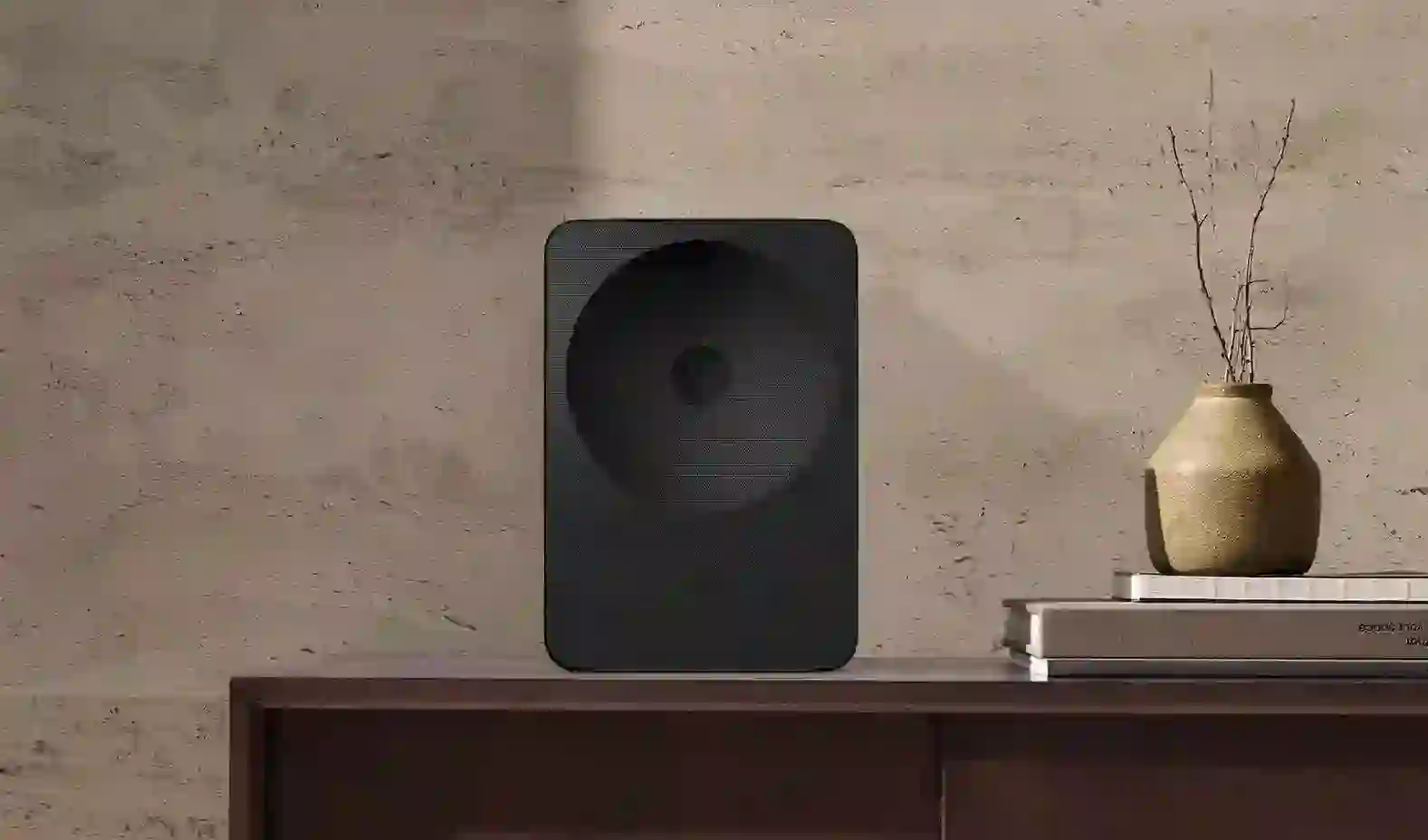
At around $500, the Samsung Music Studio 7 HW-LS70H is competing for more than just a place among premium wireless speakers. Its 3.1.1-channel design, Dolby Atmos, HDMI eARC, Q-Symphony, and extensive music streaming support make it an unusual alternative to both a conventional soundbar and a dedicated home speaker. The appeal is straightforward: one compact unit that can handle everyday music listening while also upgrading TV audio, without requiring a separate subwoofer or rear speakers.
The bigger question is whether that convenience is worth the $499.99. The Music Studio 7 offers features such as an up-firing height channel, SpaceFit Sound Pro, AirPlay 2, Google Cast, Spotify Connect, and Roon Ready support. But buyers at this price also have strong soundbars and premium wireless speakers to consider. In this Samsung Music Studio 7 review, we look at whether it’s a worthwhile all-in-one choice or a traditional soundbar or home theater setup may still make more sense.
Samsung Music Studio 7 Review: Quick Verdict
| Category | Verdict | What You Should Know |
|---|---|---|
| Music | Excellent | Wide soundstage, strong detail, and convincing spatial audio. A stereo pair can provide an even broader presentation. |
| Movies & TV | Very Good | HDMI eARC, Dolby Atmos, and strong room-filling sound make it well suited to TV use, although a soundbar with a dedicated subwoofer can deliver greater impact. |
| Dolby Atmos | Very Good | The 3.1.1-channel configuration and up-firing drivers provide noticeable height and spatial effects from a single speaker. |
| Bass | Very Good | Powerful bass for its compact size, although it can become dominant with some music and may benefit from EQ adjustment. |
| Dialogue | Very Good | Active Voice Amplifier Pro and voice-enhancement features help keep speech clear during movies and TV shows. |
| Connectivity | Excellent | HDMI eARC, optical, Wi-Fi, Bluetooth 6.0, AirPlay 2, Google Cast, Spotify Connect, Tidal Connect, and Roon Ready provide extensive connection and streaming options. |
| Ease of Use | Very Good | Straightforward setup, app-based controls, and room optimization make everyday operation simple, though there is no traditional physical remote. |
| Value for Money | Very Good | At around $499 MSRP, it combines premium music streaming, Dolby Atmos, and TV connectivity in an unusually versatile single-speaker package. |
| Best For | — | Buyers wanting one stylish speaker for both music and TV, particularly in small-to-medium rooms or alongside a compatible Samsung TV. |
| Not Ideal For | — | Home-theater enthusiasts wanting a dedicated subwoofer, discrete rear surrounds, and maximum cinematic impact. |
Bottom Line
The Samsung Music Studio 7 is best viewed as a premium music speaker that can also serve as a capable TV and Dolby Atmos system. Its biggest advantages are sound quality, extensive streaming support, HDMI eARC, and Samsung TV integration without requiring multiple speakers.
For buyers who want one compact system for both music and television, it offers a compelling combination of features. However, those building a dedicated home theater will get greater surround immersion and deeper bass from a traditional soundbar or multi-speaker system with a separate subwoofer.
Pros and Cons
Pros
- 3.1.1-channel layout with up-firing height driver for Dolby Atmos immersion
- Room-filling, detailed sound that exceeds its compact size
- Supports Wi‑Fi, Bluetooth, AirPlay, and HDMI eARC for flexible setups
- Excellent integration with Samsung TVs via Q‑Symphony and Wireless Dolby Atmos
- 24‑bit/96 kHz audio processing and super‑tweeter for high‑resolution playback
- Sleek, modern design by Erwan Bouroullec; looks like decor
- Easy setup via SmartThings app with multi‑speaker grouping and auto calibration
Cons
- No physical remote control included
- Bass can sound boomy or placement‑sensitive in some rooms
- Limited Bluetooth codec support compared with some rivals
- Premium pricing; considered a bit expensive by several reviewers
- Best features require Wi‑Fi; some users face Wi‑Fi discovery/router DFS issues
- No 3.5 mm aux input and no built‑in battery, limiting portability and wired sources
Testing note: This is a research-based review using official Samsung documentation, professional hands-on testing and customer feedback. Teckista did/did not personally test this unit.
Samsung Music Studio 7 Specifications
| Specification | Details |
|---|---|
| Model (U.S.) | HW-LS70H/ZA |
| Model (Other Regions) | HW-LS70H/XY, HW-LS70H/XU, HW-LS70H/XS, etc. |
| Product Type | Wi-Fi wireless speaker with Dolby Atmos |
| Channels | 3.1.1 |
| Number of Speakers (Drivers) | 5 |
| Total Power Output | Not officially specified by Samsung; some retailers list 150 W |
| Dolby Atmos | Yes (wired via HDMI eARC and wireless Dolby Atmos) |
| Other Dolby Formats | Dolby Atmos Music, Dolby 5.1ch, Dolby Digital Plus, Dolby TrueHD |
| HDMI | 1× HDMI Out with eARC/ARC and CEC |
| Optical Input | 1× Optical In |
| Wi-Fi | Yes, dual-band 2.4/5 GHz |
| Bluetooth | Bluetooth 6.0 |
| AirPlay | AirPlay 2 |
| Chromecast / Google Cast | Yes |
| Spotify Connect | Yes, including Spotify Tap over Wi-Fi |
| Tidal Connect | Yes |
| Roon | Roon Ready |
| Q-Symphony | Yes, with compatible Samsung TVs |
| SmartThings App | Yes |
| Room Tuning / Sound Optimization | SpaceFit Sound Pro, Active Voice Amplifier Pro, AI Dynamic Bass Control, Adaptive Sound, Standard and Music modes |
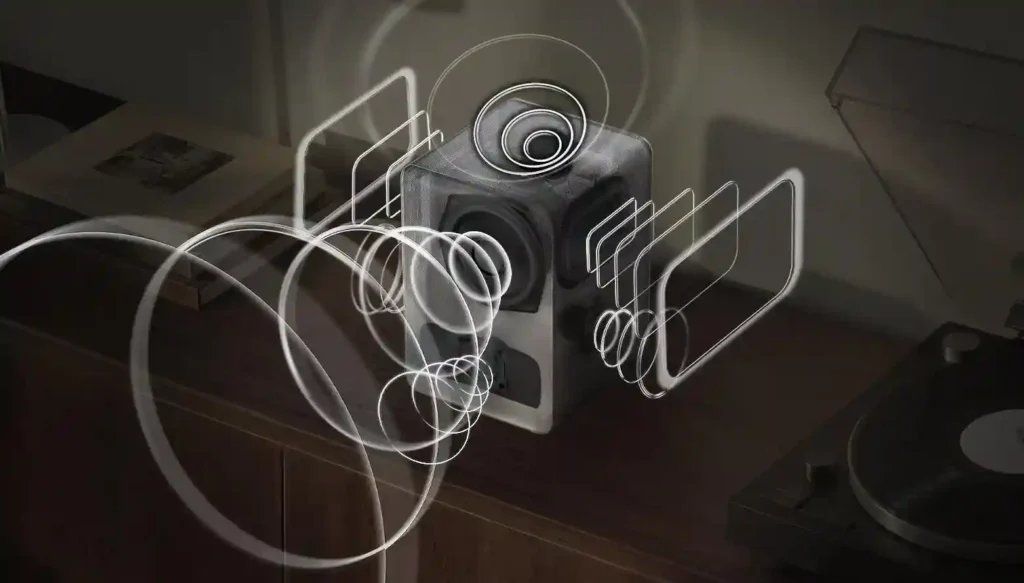
| Dimensions (W × H × D) | 185 × 269 × 190.5 mm |
| Weight | 5.6 kg |
| Package Dimensions (W × H × D) | 226 × 345 × 227 mm |
| Package Weight | 6.6 kg |
| Power Consumption (Operating) | 20 W |
| Power Consumption (Standby) | 0.5 W |
| Power Supply | Free voltage / auto-ranging AC |
| Remote Control | One Remote Control supported; no physical remote included |
| U.S. Current Price | $419.99 |
| U.S. Launch MSRP | $499.99 |
Key Features Explained
Dolby Atmos 3.1.1
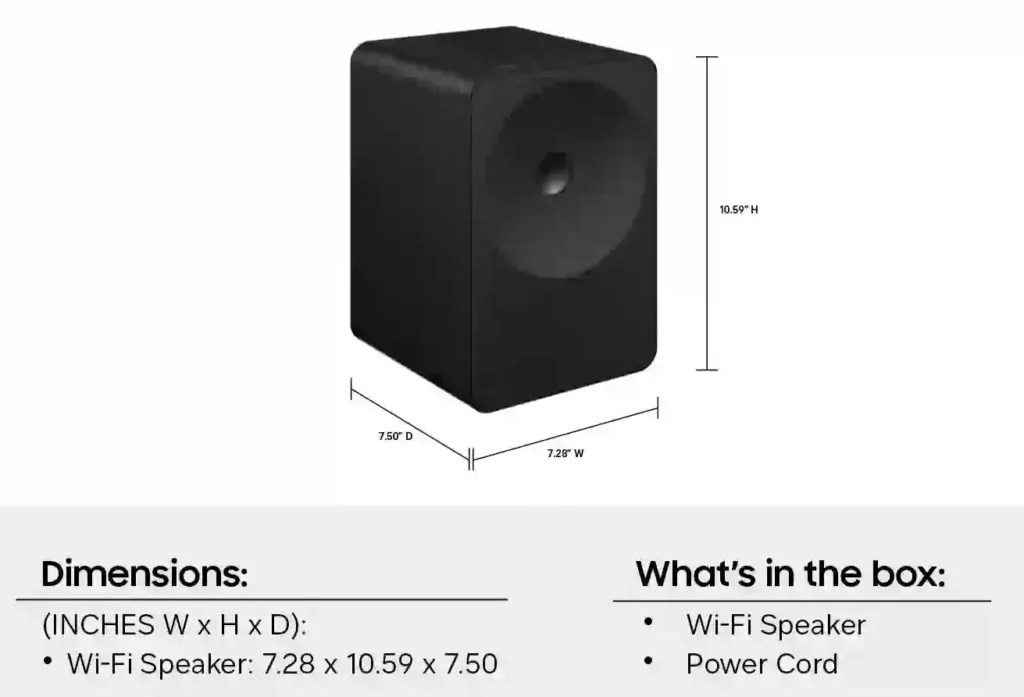
The 3.1.1 layout provides a center channel for dialogue, left and right channels for a broad front soundstage, a low‑frequency channel for bass, and an upward‑firing driver for height cues. This combination creates a more immersive experience than stereo alone because sounds can be placed above the listening area. It matters most for movies and TV shows that are mixed in Atmos and for listeners who want height effects without a full surround setup. The limitation is that a single cabinet cannot recreate full room surrounds like a multi‑speaker system, but the front‑stage and overhead sensations are convincing for a compact package.
Q‑Symphony Integration
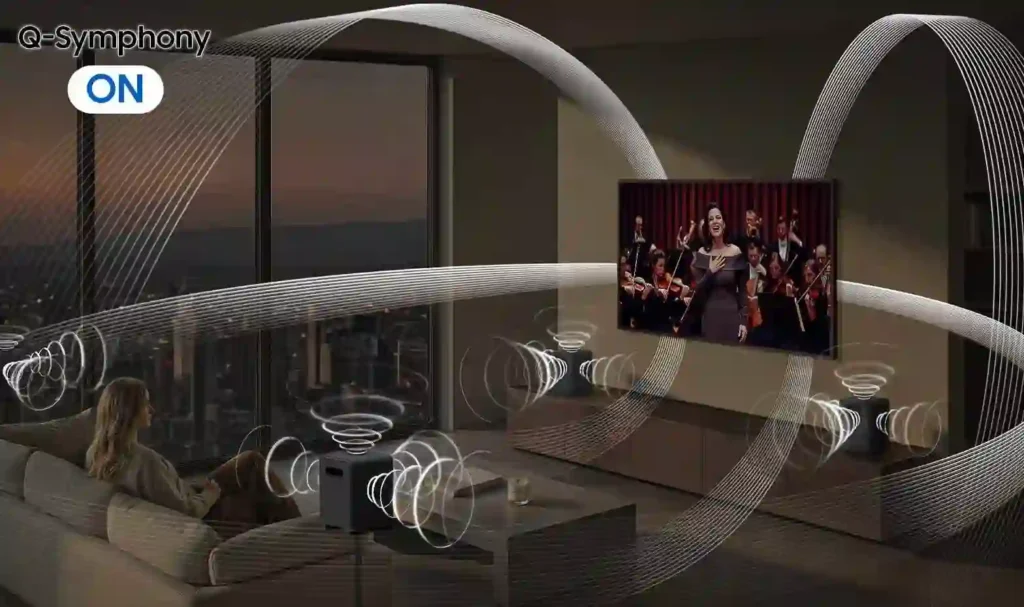
Q‑Symphony lets the Music Studio 7 work together with compatible Samsung TV speakers, providing a coordinated sound output instead of one device taking over. It benefits families that want easy pairing between TV and speaker and prefer a single ecosystem. Its usefulness depends on TV compatibility.
SpaceFit Sound Pro Room Tuning
SpaceFit Sound Pro uses onboard microphones and algorithms to tailor the speaker’s tuning to the room. The feature is intended to automatically adjust the speaker’s sound according to room acoustics, reducing the need for manual tuning. This helps when the speaker sits on a TV stand, shelf, or wall unit in varying room acoustics. It is particularly useful for buyers who want a plug‑and‑play experience. The trade‑off is that room tuning cannot compensate for extreme placement mistakes or very large rooms.
AI Dynamic Bass Control and AI Active Voice Amplifier
AI Dynamic Bass Control analyzes and adjusts low-frequency reproduction according to the content and listening conditions. Samsung positions the feature as a way to manage bass dynamically; its effectiveness will depend on content, volume and room acoustics. AI Active Voice Amplifier boosts dialogue levels dynamically to improve intelligibility for TV shows and podcasts. These features matter if clarity and balanced bass are priorities, but they are algorithmic aids and do not replace the benefits of dedicated external components for users seeking deep, physical subwoofer impact.
Who Should Buy Samsung Music Studio 7?
Ideal Buyers
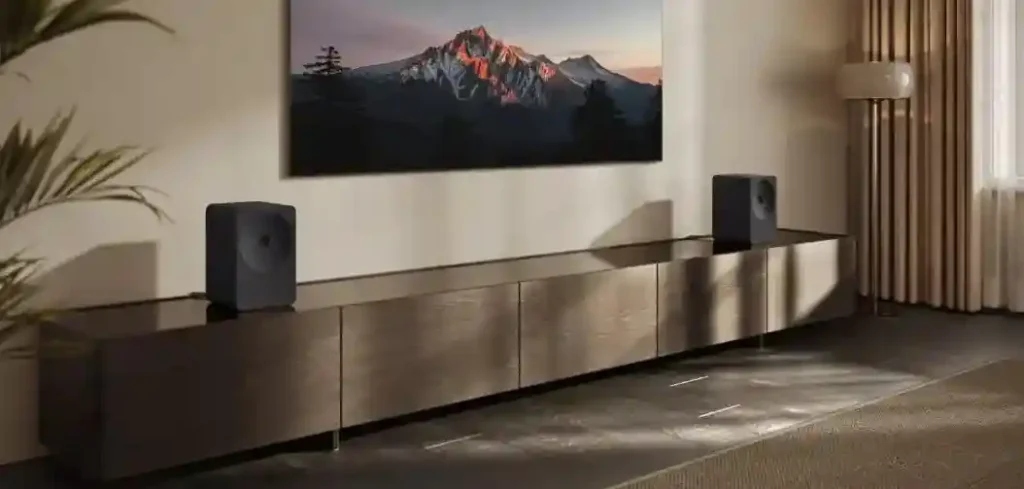
The Music Studio 7 is ideal for people who want an out‑of‑the‑box Dolby Atmos experience in a single speaker. It suits those who value seamless pairing with Samsung TVs, straightforward setup, strong bass for a compact unit, and improved dialogue clarity. Small to medium living rooms where running wires and placing multiple speakers is impractical are a perfect fit.
Who Should Avoid It
Listeners who expect a dramatic leap in audible performance over the Music Studio 5 at normal listening levels, may prefer to consider other options. People seeking true multi‑speaker surround performance without adding extra speakers should also look elsewhere.
Connectivity and Streaming
Connectivity is one of the Samsung Music Studio 7’s stronger areas. It combines wired TV connections with Wi-Fi streaming, Bluetooth, popular music platforms, and additional features for Samsung TV owners.
HDMI eARC and Optical
For TV use, HDMI eARC is the best connection. A single HDMI cable can send audio from a compatible TV to the Music Studio 7, including Dolby Atmos when supported by the TV and content. HDMI CEC also allows compatible TVs to control basic functions such as speaker volume using the TV remote.
An optical digital input is available for older TVs and other compatible devices that do not have HDMI ARC or eARC. It is a useful fallback, although optical has more limited audio-format capabilities than HDMI eARC.
One limitation is the lack of an HDMI input. Game consoles, streaming boxes and Blu-ray players therefore need to connect directly to the TV rather than passing through the Music Studio 7.
Wi-Fi and Bluetooth
Wi-Fi is important if you want to take full advantage of the Music Studio 7. Beyond wireless music playback, it supports features such as multi-speaker grouping, compatible streaming platforms and integration with Samsung’s ecosystem.
Bluetooth 6.0 provides a simpler option for quickly playing audio from a phone, tablet or laptop without relying on Wi-Fi. However, Bluetooth is better viewed as the convenient connection method, while Wi-Fi is the more capable choice for home streaming.
AirPlay, Chromecast, Spotify, Tidal and Roon
The Music Studio 7 supports a broad selection of streaming technologies, making it suitable for households using different devices and music services.
AirPlay 2 provides convenient streaming for iPhone, iPad and Mac users, while Google Cast makes it easy to cast compatible audio from supported apps and devices. Spotify Connect and Tidal Connect allow music to be controlled through their respective apps while the speaker handles playback directly.
Roon Ready support is another useful addition for enthusiasts who use Roon to organize and play their digital music libraries.
This broad streaming support is a significant advantage for buyers who want the Music Studio 7 to serve as both a TV speaker and their main wireless music system.
SmartThings and Voice Control
Samsung’s SmartThings ecosystem provides additional control over the Music Studio 7, including setup and compatible audio features.
The speaker also works with Google Home and Alexa, allowing it to fit more easily into an existing smart-home setup. Bixby support is not listed for this model.
Q-Symphony With Samsung TVs
Samsung TV owners receive an additional advantage through Q-Symphony. With a compatible Samsung TV, Q-Symphony allows the television’s built-in speakers and the Music Studio 7 to work together rather than automatically disabling the TV speakers.
The result can be a larger and more immersive presentation than using the Music Studio 7 alone. However, Q-Symphony is an ecosystem-specific benefit, so owners of TVs from other brands will need to use connections such as HDMI eARC or optical instead.
Multi-Room and Stereo Pairing
The Music Studio 7 can also work with additional compatible Samsung speakers, but it is important to understand what this means.
Group Play can synchronize music across multiple compatible Samsung Wi-Fi speakers, making it useful for multi-room listening. However, this should not be confused with adding dedicated rear surround channels for movies. Group Play is intended for synchronized music playback and does not turn several Music Studio speakers into a conventional 5.1 or 7.1 surround system.
Two compatible Music Studio 7 speakers can also be paired for wider stereo playback. This can improve left-to-right separation for music compared with using a single speaker.
Buyers specifically wanting discrete rear speakers and a separate subwoofer should therefore consider a traditional expandable soundbar or home-theater system instead.
Connectivity Limitations
The Music Studio 7 offers excellent connectivity for an all-in-one wireless speaker, but there are a few limitations worth knowing before buying:
- There is no HDMI input for connecting a console, Blu-ray player or streaming box directly to the speaker.
- Multi-room Group Play should not be confused with dedicated rear-surround speaker support.
- Q-Symphony requires a compatible Samsung TV.
- Bluetooth is convenient, but Wi-Fi or HDMI eARC makes more sense when prioritizing the Music Studio 7’s full capabilities.
Design and Build Quality
The Music Studio 7 combines a soundbar‑style silhouette with a modern, elegant look attributed to a named designer. Multiple reviews describe the speaker as well built and visually appealing, fitting neatly under most TVs or on cabinets. Materials and finish specifics are not published in detail, but the overall impression is of a premium single‑unit device rather than a budget plastic speaker. Placement considerations center on front‑and‑center positioning below the TV to maximize the benefit of center and upward‑firing drivers.
Setup and Installation
Setup is straightforward: place the Samsung Music Studio 7 in your listening area, connect it to power, and link it to your TV or source. For the best TV experience, use an HDMI eARC cable from the TV’s HDMI ARC/eARC port to the speaker’s HDMI OUT, then enable HDMI‑CEC (Anynet+) and eARC in the TV’s sound settings and set audio output to external speakers/Audio System. Wireless options include Bluetooth and Wi‑Fi streaming through the Samsung Sound/Music Studio app, which also handles multi‑speaker grouping. The speaker uses automatic room tuning to optimize sound for your space, and it integrates smoothly with Samsung TVs via Q‑Symphony and Wireless Dolby Atmos when used in a compatible setup. For detailed instructions, refer to the official Samsung Music Studio 7 user manual.
Samsung Music Studio 7 vs Soundbar: Which Should You Buy?
The Samsung Music Studio 7 and a similarly priced traditional soundbar can both provide a major upgrade over built-in TV speakers, but they serve different priorities.
Movies and Dolby Atmos
The Music Studio 7 uses a 3.1.1-channel Dolby Atmos configuration to create a more immersive experience from a single speaker. However, a traditional soundbar paired with a dedicated subwoofer and rear speakers can deliver deeper bass and more convincing surround effects. If movies and home theater are your main priorities, an expandable soundbar system has the advantage.
Music
Music is where the Music Studio 7 becomes particularly appealing. It supports Wi-Fi streaming along with AirPlay 2, Google Cast, Spotify Connect, Tidal Connect, and Roon Ready. Its all-in-one design makes it better suited to buyers looking for one premium speaker for both music and TV rather than a system primarily designed around home theater.
Bass
The Music Studio 7 can produce strong bass from its single enclosure, but a soundbar with a dedicated wireless subwoofer will generally provide deeper and more impactful low frequencies. This difference becomes more noticeable with action movies and bass-heavy content.
Connectivity and Setup
The single-speaker design requires less space and setup than a soundbar system with a separate subwoofer and rear speakers. Samsung TV owners also gain Q-Symphony integration.
Which Should You Buy?
Choose the Samsung Music Studio 7 if you want a stylish, compact all-in-one speaker that prioritizes music while still providing Dolby Atmos TV audio.
Choose a traditional soundbar if movies are your main priority and you want deeper bass, dedicated surround speakers, and greater home-theater expansion options.
Real‑World Performance
Movies and TV
For movies and Atmos‑mixed TV shows, the Music Studio 7 delivers an immersive front‑stage with credible height effects. The upward-firing driver is designed to reproduce height information in Dolby Atmos content, providing an additional spatial dimension compared with conventional stereo playback. Dialogue clarity benefits from the dedicated center channel and AI Active Voice Amplifier. Bass is described as strong and controlled, providing satisfying impact for explosions and low frequency effects for the size of the unit. Customer reviews indicate that the speaker can produce room-filling output suitable for many small-to-medium living spaces. The limitation is that front‑stage immersion, while impressive for a single speaker, will not fully match a room filled with separate rear surrounds and a dedicated subwoofer.
Music Listening
Music playback is a definite strength. Reviews highlight warm, balanced vocals and lively dynamics, with instrument separation that feels wider than expected from a single cabinet. The integrated low‑frequency channel and AI Dynamic Bass Control keep bass punchy and controlled, which helps genres that rely on rhythmic low end. For casual and critical listening in living rooms, the Music Studio 7 offers enjoyable performance. Audiophiles who prefer discrete stereo imaging from two separate speakers or deeper subwoofer extension may find the single‑unit format limiting, but for most listeners the soundstage and tonal balance are very good.
Gaming
Dedicated gaming tests were not published in the available material, so definitive conclusions on positional accuracy and latency cannot be made. The 3.1.1 layout and Dolby Atmos support suggest potential for immersive gaming audio, especially for height cues in Atmos‑supported titles. However, buyers who prioritize low latency and precise positional cues for competitive gaming should seek hands‑on gaming reviews or consider a system with known low‑latency HDMI paths.
Best Samsung Music Studio 7 Settings
| Use Case | Recommended Sound Mode | SpaceFit Sound Pro | Active Voice Amplifier | Bass Setting | Other Recommended Settings | Why |
|---|---|---|---|---|---|---|
| Movies | Adaptive Sound | On | On | Bass Enhancement On or +2 to +4 | Voice Enhancement On; Night Mode Off; Virtual On if available | Improves cinematic impact, room optimization, dialogue clarity, and immersion |
| Music | Music | On | Off | Bass Enhancement Off or 0 to +2 | Voice Enhancement Off; Night Mode Off; Virtual Off | Provides a more natural tonal balance while preserving music detail |
| TV Shows | Adaptive Sound | On | On | Bass Enhancement Off or 0 to +2 | Voice Enhancement On; Night Mode Off; Auto Volume On if needed | Balances changing content while keeping dialogue clear |
| Dialogue / News | Standard or Adaptive Sound | On | On | Bass Enhancement Off; Bass 0 or -1 | Voice Enhancement On; Auto Volume On if available | Prioritizes speech clarity and reduces low-frequency masking |
| Gaming | Adaptive Sound | On | Off | Bass Enhancement On or +2 to +4 | Voice Enhancement Off; Night Mode Off; adjust Audio Sync if needed | Adds impact to effects while maintaining dynamic game audio |
| Night Viewing | Adaptive Sound or Standard | On | On | Bass Enhancement Off; Bass -1 to 0 | Night Mode On; Voice Enhancement On; Auto Volume On if available | Improves dialogue at low volume while reducing loud peaks and excessive bass |
Note: These settings should be treated as recommended starting points rather than universal settings. Room acoustics, speaker placement, listening volume, TV model, and personal preference can affect the ideal configuration.
Amazon Customer Samsung Music Studio 7 Review Rating
| Stars (4.9/5) | Review (16 global ratings) |
| 5 Star | 92% |
| 4 Star | 8% |
| 3 Star | 0% |
| 2 Star | 0% |
| 1 Star | 0% |
Rating checked on 5 September 2026
What Owners Are Saying
Among the limited customer feedback available, Samsung Music Studio 7 is praised for its rich, room-filling sound that easily exceeds expectations for a single wireless speaker. We found that users consistently appreciate the deep, controlled bass, clear vocals, and detailed highs, making it suitable for movies, music, and casual TV viewing.
Many reviewers also highlight the premium build quality and elegant design, saying the speaker looks as good as it sounds. The wireless connectivity, quick setup, and stable Bluetooth or Wi-Fi performance receive frequent compliments, making everyday use hassle-free. The speaker maintain clarity even at higher volume levels without distortion. Also it performs well across different music genres, from pop and rock to classical and electronic tracks.
Samsung Music Studio 7 Competitor Comparison
| Feature | Samsung Music Studio 5 | Sonos Era 300 | Apple HomePod (2nd Gen) | Devialet Mania | Bowers & Wilkins Formation Flex | Samsung Music Studio 7 |
|---|---|---|---|---|---|---|
| Audio Configuration | 2.0-channel, 3-driver design | 6-driver spatial audio design with side and up-firing drivers | High-excursion woofer with five beamforming tweeters | Four full-range drivers and two woofers, 176 W | Two-way active speaker with tweeter and woofer | 3.1.1-channel, 5-driver design with front, side and up-firing drivers, 150 W |
| Dolby Atmos | Yes, but without a dedicated up-firing height driver | Yes | Yes, when used with Apple TV 4K | No | No | Yes, with dedicated up-firing height driver |
| HDMI eARC | No | No | No | No | No | Yes (HDMI eARC input/output) |
| Wi-Fi / Bluetooth | Wi-Fi 5 / Bluetooth 6.0 | Wi-Fi 6 / Bluetooth 5.3 | Wi-Fi / Bluetooth | Wi-Fi / Bluetooth 5.0 | Wi-Fi / Bluetooth | Wi-Fi 6 / Bluetooth 6.0 |
| AirPlay / Chromecast | AirPlay 2 / Chromecast | AirPlay 2 / No Chromecast | AirPlay 2 / No Chromecast | AirPlay 2 / No Chromecast | AirPlay 2 / No Chromecast | AirPlay 2 / Chromecast (Google Cast) |
| Main Advantage | Lower price and same Samsung ecosystem | Excellent spatial audio and mature Sonos ecosystem | Strong Apple integration and lower price | Premium music performance and portability | Hi-fi-focused wireless music performance | Best Samsung ecosystem speaker for TV and music with HDMI eARC and true 3.1.1 Atmos |
| Main Limitation | Less immersive than Music Studio 7 and no HDMI eARC | No direct HDMI eARC; TV use is better with a Sonos soundbar | Apple-centric and no direct TV connection | No Dolby Atmos or HDMI eARC | No Dolby Atmos or HDMI eARC | Premium price; bass and tuning can be room/placement dependent |
| Best For | Samsung users wanting a cheaper alternative | Music-first buyers who prioritize Dolby Atmos music | Apple households using Apple TV and iPhone | Buyers prioritizing premium music and portability | Hi-fi listeners focused mainly on music | Samsung/Android households wanting one premium speaker for both TV (via HDMI eARC) and high-quality music with Atmos |
Final Verdict
The Samsung Music Studio 7 makes the most sense for buyers who want one premium speaker to handle both music and TV audio without building a larger home-theater system. Its strongest advantage is versatility: it combines extensive music streaming support with HDMI eARC, Dolby Atmos, and useful Samsung TV features in a compact single-speaker design.
At its $499.99 MSRP, the value depends heavily on how much you will use both sides of that equation. Music-first buyers who also want a capable TV upgrade are likely to get more from it than viewers focused primarily on movies and surround sound.
If maximum cinematic impact, deeper sub-bass, and dedicated rear channels are priorities, a traditional soundbar system is the better choice. For buyers prioritizing simplicity, music playback, and TV integration in one device, the Music Studio 7 is a strong all-in-one alternative.
How This Product Was Evaluated
This review focused on the speaker’s channel layout, listed power, Dolby Atmos support, adaptive and AI features, and real‑world performance as described in early professional coverage and retailer information. Sound behavior for movies, music, and voice content was assessed based on documented reviewer impressions. Product positioning against the Music Studio 5 and practical setup considerations were also reviewed to guide buying decisions.
How many channels does the Music Studio 7 have?
The speaker uses a 3.1.1 channel configuration.
Does the Music Studio 7 support Dolby Atmos?
Yes, the Music Studio 7 supports Dolby Atmos.
Does Samsung Music Studio 7 support Q‑Symphony with Samsung TVs?
Yes, Q‑Symphony is supported for compatible Samsung TVs.
How much power does the Music Studio 7 output?
Retail listings cite a total output of 150 W.
Can Samsung Music Studio 7 connect with other Samsung speakers?
The unit does not ship with dedicated rear speakers but supports wireless grouping with additional Samsung audio devices.
Does the Samsung Music Studio 7 package include a subwoofer?
No separate external subwoofer is included. The Music Studio 7 handles bass within its single-speaker enclosure.
Is It Worth Buying Samsung Music Studio 7?
The Samsung Music Studio 7 is worth considering if you want one premium speaker for both music and TV, particularly if you own a compatible Samsung TV. Buyers focused primarily on home theater may get better value from a soundbar system with a dedicated subwoofer and optional rear speakers.