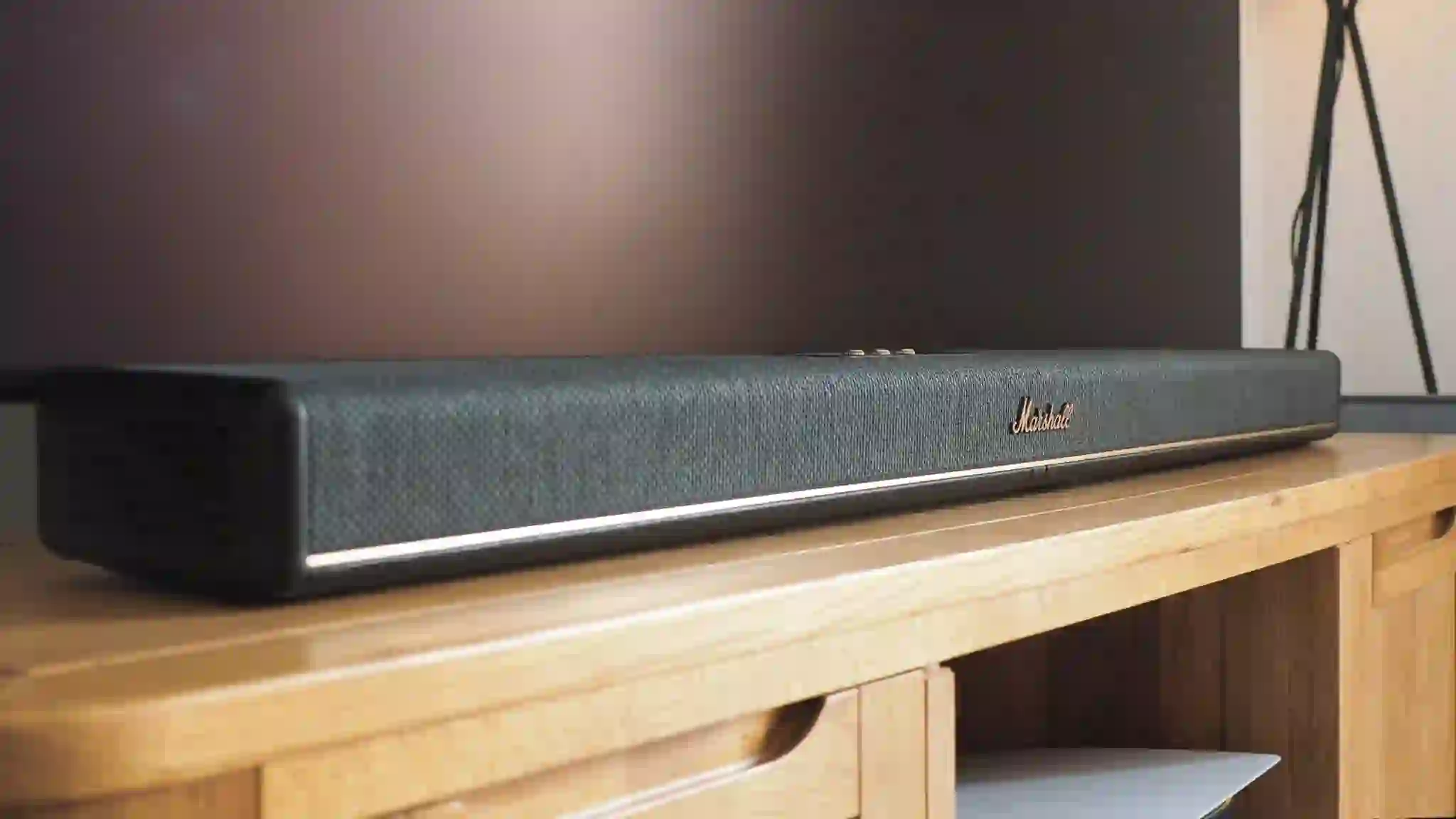
We are looking at the Marshall Heston 120 review to help determine if this is the right soundbar for a premium home setup. The Heston 120 is Marshall’s all-in-one 5.1.2 soundbar launched in 2025. It targets people who want object-based audio Dolby Atmos and DTS:X without adding discrete rear speakers or an immediate external subwoofer. Key strengths include native Atmos and DTS:X support, an 11-driver layout that simulates a multi-channel system, built-in bass hardware with passive radiators, and a broad streaming ecosystem that covers AirPlay 2, Spotify Connect, TIDAL Connect and Google Cast.
Key limitations are a premium MSRP, a large physical footprint near 1.1 meters wide and the fact that wall-mount brackets are not included in the box. In this article we will cover what the Heston 120 is designed to do, how it behaves in different real-world scenarios, setup advice, best sound settings you can rely on, who should buy it, who should not, and how it compares with close competitors. This Marshall Heston 120 review is designed to make the buying decision easier.
Marshall Heston 120 Review: Quick Verdict
Best For
Buyers who want a single-unit 5.1.2 Atmos/DTS:X soundbar with built-in bass and wide streaming support.
Not Ideal For
Those on tight budgets, people with very small TVs or rooms where a 1.1 meter soundbar would overwhelm the setup, or anyone expecting included wall brackets.
Top Strengths
Native Dolby Atmos and DTS:X support, integrated bass hardware with SUB OUT for expansion, broad streaming options and HDMI eARC plus pass-through.
Biggest Weaknesses
Premium price and large footprint; mounting hardware must be bought separately.
Bottom Line
The Marshall Heston 120 REVIEW shows a bold all-in-one Atmos approach. It blends Marshall styling with a feature set tailored to buyers who want immersive audio without adding satellite speakers immediately. The price and size are the trade-offs.
Product Overview
The Marshall Heston 120 sits in the premium TV soundbar category as an all-in-one 5.1.2 solution released in 2025. Highlights include object-based audio support for both Dolby Atmos and DTS:X, an 11-driver configuration for spatial presentation, and integrated low-frequency hardware—two rear-firing sub drivers and passive radiators—so deep bass does not require an external sub out of the box. Connectivity is broad with HDMI eARC, HDMI pass-through, Wi‑Fi, Ethernet, Bluetooth and native support for AirPlay 2, Spotify Connect, TIDAL Connect and Google Cast. Market positioning is premium, aimed at buyers who want a single-piece upgrade to TV audio and music streaming without committing to a full multi-speaker system.
Marshall Heston 120 Specifications
| Specification | Value |
|---|---|
| Channels | 5.1.2 |
| Drivers | 11-driver layout |
| Dolby Support | Dolby Atmos |
| DTS Support | DTS:X |
| Built-in Bass Hardware | 2 rear-facing sub drivers and 4 passive radiators; SUB OUT line-level output |
| Connectivity | HDMI eARC/ARC, HDMI pass-through, Wi‑Fi, Bluetooth, AirPlay 2, Spotify Connect, TIDAL Connect, Google Cast, RCA analog input, Ethernet/LAN |
| Dimensions (W x H x D) | 1100 x 145 x 76 mm (43.3 x 5.7 x 3.0 in) |
| Weight | 7.04 kg (7040 g) |
| MSRP | US $1,299.99 |
Why These Specifications Matter
When we look for a soundbar, channels and supported formats dictate how immersive the sound can be for movies and shows. The 5.1.2 configuration in the Heston 120 means object-based audio like Dolby Atmos and DTS:X can be reproduced with height cues and surround effects from a single enclosure. The large driver complement and built-in bass hardware reduce the need to buy a separate subwoofer immediately, which is convenient if space or budget for a full system is limited.
HDMI eARC ensures the soundbar can receive full-resolution object-based audio from TVs that support eARC. Streaming support from AirPlay 2, Spotify Connect, TIDAL Connect and Google Cast makes the Heston 120 useful as a music device as well as a TV upgrade. The size and weight matter too. This is a substantial, premium piece that needs space centered under a TV.
Key Features Explained
Dolby Atmos and DTS:X
Both object-based formats let sound designers place audio objects anywhere in the room, including overhead. The Heston 120 supports both, which matters if movies, consoles or streaming apps deliver Atmos or DTS:X tracks. Those who watch modern film releases, Atmos-enabled streaming shows or compatible game audio will see the most benefit. Limitations are inherent to single-enclosure systems—actual overhead reproduction depends on driver placement, room acoustics and the listener position.
11-Driver Layout and 5.1.2 Simulation
The soundbar uses multiple drivers arranged to cover left, center, right, surrounds and height channels. The practical benefit is more believable surround and positional effects without adding wireless rear speakers. This suits living rooms where adding satellites is impractical. The trade-off is that integrated surround rendering can be room dependent; results vary by listening position and room geometry.
Built-in Bass Hardware and SUB OUT
Two rear-facing sub drivers and passive radiators aim to deliver satisfying low-end without an external sub. This is a major convenience for people who prefer a simpler setup. If deeper extension or higher output is needed, a line-level SUB OUT is available to add a powered sub. That flexibility means users can start with the all-in-one solution and expand if they want more bass later.
Streaming Ecosystem
Native support for AirPlay 2, Spotify Connect, TIDAL Connect and Google Cast makes the Heston 120 a flexible music speaker. Streaming from phones and services is easy and often higher quality than Bluetooth alone. The advantage is daily music use without extra hardware; the limitation is dependent on the streaming service and network stability, not the soundbar itself.
HDMI eARC/Pass-through and App-Based Room Correction
Using HDMI 1 to the TV eARC port lets the soundbar receive object-based audio from TV apps or routed devices. HDMI pass-through keeps source connections simple. The Marshall app includes a room correction step to tune performance for placement, which helps address room-specific imbalances. App-based correction is useful, though exact performance depends on the calibration routine and the room.
Who Should Buy Marshall Heston 120?
Ideal Buyers
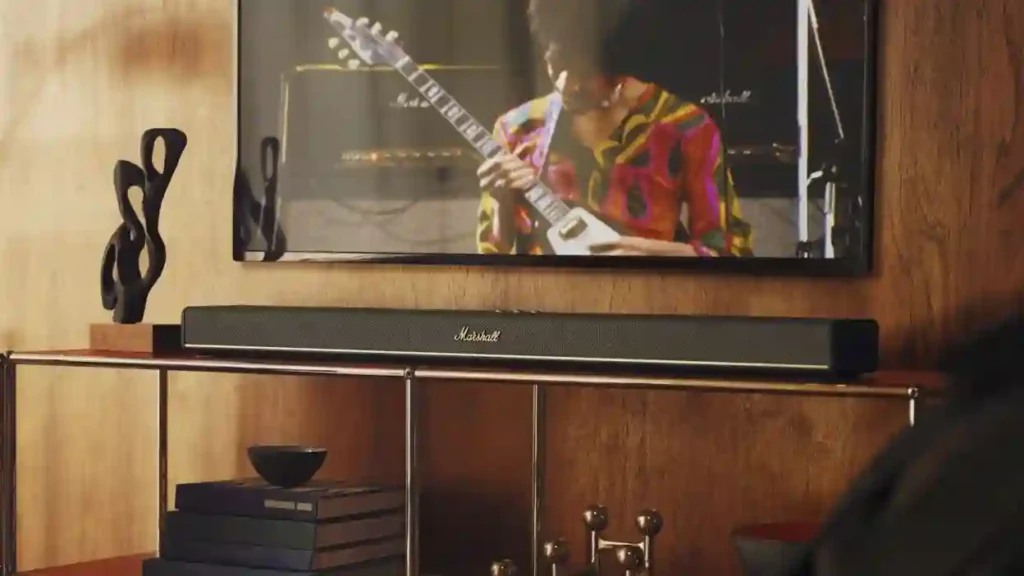
Buyers who want a premium single-unit 5.1.2 Atmos soundbar with integrated bass and wide streaming options. People who appreciate Marshall styling and need an upgrade from TV speakers without immediately adding separate satellites. Those who value easy streaming and app-driven calibration.
Who Should Avoid It
Users on tight budgets or those who have very small TVs or limited shelf space where a 1.1 meter wide bar is impractical. Anyone who expects wall-mount brackets in the box or who needs detailed warranty and power specs up front.
Best Use Cases
Home cinema enthusiasts who want object-based audio with less wiring, music listeners who want streaming convenience and living rooms where a single-piece system is preferable to a speaker cluster.
Less Suitable Use Cases
Very small rooms where the bar would dominate visually, buyers who want a full discrete speaker system from day one or those needing included mounting hardware.
Design and Build Quality
The Heston 120 adopts Marshall’s premium aesthetic in a large, solidly built enclosure finished in black. Appearance leans toward stage-presence and classic Marshall styling. Specific materials are described as premium but exact material lists are not outlined. Durability impressions from professional reviewers are positive on build solidity, though long-term ownership data is not available. Placement considerations matter: the physical footprint is around 1.1 meters wide and it is best centered under the TV with clearance as recommended in the app-based setup. For wall mounting there are mounting points, but brackets are not included. Practical usability is high for those who value a tactile product with broad inputs and streaming; less practical for minimal or cramped setups.
Setup and Installation
Setup is straightforward if the recommended steps are followed you can refer the official Marshall Heston 120 user manual for that. The Marshall app guides initial configuration, including a room correction routine. For the best movie experience connect HDMI 1 on the Heston 120 to the TV’s eARC/ARC port and ensure the TV is set to pass object-based audio over eARC. Bluetooth pairing is supported through the app. Ethernet is an option if Wi‑Fi is not preferred. Common setup pitfalls include using the wrong HDMI port on the TV and discovering wall-mount brackets are not included. Overall setup is typical for modern soundbars: central placement, a power and HDMI connection, then app calibration.
Sound Performance
Movie Performance
For movies, the Heston 120’s 5.1.2 layout and native Dolby Atmos and DTS:X support are the primary attractions. Dialogue clarity is emphasized by the manufacturer and professional reviewers note the unit handles movie soundtracks competently. Built-in rear-facing sub drivers and passive radiators aim to provide satisfying low-end for explosions and LFE passages without an external sub. If the room or listening taste demands more rumble, the SUB OUT lets owners add a powered sub.
Surround and height effects are presented from the single enclosure and are designed to deliver immersive cues in many living room settings. Exact measured performance varies by room and listening position, but the configuration and driver count point to a strong film-oriented package for buyers who want simpler wiring.
Music Performance
As a music speaker the Heston 120 benefits from native streaming options including AirPlay 2, Spotify Connect, TIDAL Connect and Google Cast. Vocals and instruments are expected to perform well thanks to the multi-driver approach and Marshall’s tuning for both TV and music use. The integrated bass hardware offers more low-frequency presence than many ultra-slim soundbars, improving the listening experience for bass-forward genres. For serious audiophiles who prioritize separate components or precise stereo imaging, a dedicated stereo system will still be superior. For most buyers who want music from their soundbar, the Heston 120 provides a versatile daily-driver.
Gaming Performance
The soundbar’s HDMI pass-through and Atmos support make it friendly to current consoles that can output object-based audio. Positional audio benefits when games deliver Atmos mixes, and the Heston 120’s driver layout is intended to make in-game cues clearer than TV speakers. Low-latency gaming features like specific game modes or measured input lag are not verified in available documentation, so serious competitive gamers should verify latency on their own setups. For immersive single-player or cinematic gaming sessions, the Heston 120’s Atmos support is an advantage.
Dialogue Clarity
The Heston 120 is positioned to deliver clear dialogue for TV shows and news. Manufacturer claims of depth and clarity are echoed by reviewers. App-based room correction can further improve vocal presence. For listeners who consume spoken-word content frequently, this soundbar should make dialogue easier to follow than typical TV speakers.
Bass Performance
Two rear-facing sub drivers and passive radiators aim to deliver satisfying low-end without an external sub. This is a major convenience for people who prefer a simpler setup. If deeper extension or higher output is needed, a line-level SUB OUT is available to add a powered sub. That flexibility means users can start with the all-in-one solution and expand if they want more bass later.
Surround Sound Performance
The soundbar uses multiple drivers arranged to cover left, center, right, surrounds and height channels. The practical benefit is more believable surround and positional effects without adding wireless rear speakers. This suits living rooms where adding satellites is impractical. The trade-off is that integrated surround rendering can be room dependent; results vary by listening position and room geometry.
Best Settings
For movies connect the Heston 120’s HDMI 1 to the TV eARC/ARC port to ensure Atmos or DTS:X is passed through correctly. Use the Marshall app’s room correction during initial setup to optimize tonal balance and spatial presentation for the room. For music use native streaming protocols such as AirPlay 2, Spotify Connect, TIDAL Connect or Google Cast for the best reliability and quality. If more bass is desired, add an active subwoofer via the SUB OUT line-level connection. These steps reflect recommended settings and setup flows.
Amazon Customer Marshall Heston 120 Review Rating
| Stars (4.8/5) | Review (5 global ratings) |
| 5 Star | 75% |
| 4 Star | 25% |
| 3 Star | 0% |
| 2 Star | 0% |
| 1 Star | 0% |
Why Users Are Giving 4 and 5-Star Reviews
Most users give the Marshall Heston 120 high ratings because it delivers powerful, room-filling sound without requiring an external subwoofer. Many reviewers are surprised by the amount of bass produced by the built-in drivers, saying it adds plenty of impact for movies while remaining clean and controlled. At the same time, vocals stay crisp and easy to understand, even during action scenes.
Another reason buyers are impressed is the wide Dolby Atmos soundstage. Many feel the soundbar creates an immersive home theater experience, making movies, TV shows, and music much more engaging. Users also appreciate the ability to fine-tune the audio through the Marshall app, allowing them to customize the sound to their preferences.
The iconic Marshall design is another major highlight. Reviewers frequently mention the premium leather finish, tactile control knobs, and vintage amplifier styling that make it stand out from ordinary soundbars. Buyers also praise its solid build quality, multiple connectivity options, and easy setup. Overall, most users believe the Marshall Heston 120 successfully combines premium sound, elegant design, and excellent movie and music performance, making it a worthwhile investment despite its premium price.
Connectivity and Smart Features
The Heston 120 supports Wi‑Fi and offers Ethernet as an option. Bluetooth pairing is supported for convenience. Native streaming support includes AirPlay 2, Spotify Connect, TIDAL Connect and Google Cast so the soundbar integrates well with phones and streaming services. HDMI eARC ensures high-quality audio from TV source apps, and HDMI pass-through keeps source management simple. The Marshall app is used for initial setup and room correction. Voice assistant integration is not verified in available materials.
Common Problems and Troubleshooting
A few recurring setup issues are foreseeable. If Atmos or DTS:X content from the TV does not reach the soundbar in object-based form, check that HDMI 1 on the Heston 120 is connected to the TV’s eARC/ARC port and ensure the TV audio output is set to pass-through/eARC. If wall mounting is planned, remember brackets are not included and need to be purchased separately. Bluetooth pairing issues follow typical troubleshooting: follow the app pairing flow, restart devices, move closer, and check for firmware updates. If bass is lacking, use the SUB OUT to add a powered subwoofer.
Competitor Comparisons
Sonos Arc Ultra
When comparing the Marshall Heston 120 REVIEW with the Sonos Arc Ultra, consider ecosystem preferences. Choose the Heston 120 if a single-piece solution with integrated bass hardware and SUB OUT is preferred and Marshall styling matters. Choose the Sonos Arc Ultra if the Sonos multi-room ecosystem and Sonos-specific features are important to the household. Direct side-by-side spec and price differences vary by region and timing.
Other Premium Soundbars
Other premium options from manufacturers like Samsung, Sony or Bose occupy the same market segment. Choose the Heston 120 if the combination of integrated sub drivers, multiple passive radiators, 11-driver layout and wide streaming support match priorities. Choose another brand if ecosystem-specific features, included satellite speakers or different mounting options better solve the room or budget constraints.Comparison Table
Availability and Value for Money
The Marshall Heston 120 review shows a product that packs object-based audio, a substantial driver array and built-in bass hardware into one enclosure. For buyers who value simplifying a home cinema setup while retaining Atmos and DTS:X, the feature set justifies consideration. The price is at the premium end and will be a deciding factor for many. The value is strongest for those who want Marshall styling, integrated bass and wide streaming options combined in a single, upgradeable unit.
Pros and Cons
Pros
- Native Dolby Atmos and DTS:X support
- 5.1.2 configuration in a single enclosure
- Built-in rear-facing sub drivers and passive radiators plus SUB OUT
- Wide streaming support: AirPlay 2, Spotify Connect, TIDAL Connect, Google Cast
- HDMI eARC/ARC plus HDMI pass-through
- App-based room correction for calibration
Cons
- Premium MSRP US $1,299.99
- Large physical footprint (1100 mm width) may not suit smaller TVs
- Wall-mount brackets not included
- Some technical details not published in initial materials
Final Verdict
The Marshall Heston 120 review presents an ambitious all-in-one approach to premium TV audio. Biggest strengths are native Dolby Atmos and DTS:X, an 11-driver layout offering 5.1.2 presentation, built-in bass hardware that reduces the need for an immediate subwoofer, and broad streaming options. Biggest weaknesses are the premium MSRP and the large physical footprint, plus missing wall-mount hardware in the box. The Heston 120 is best for buyers seeking immersive object-based audio without the fuss of discrete rear speakers and who appreciate Marshall’s aesthetic.
It is not ideal for budget buyers, very small TVs or those who expect complete mounting hardware in the package. On balance the Heston 120 is a strong choice for a specific buyer profile looking to upgrade their TV sound and music streaming experience with a single, feature-rich unit.
How This Product Was Evaluated
This review evaluated the Heston 120’s verified specifications, feature set, setup and connectivity options, and professional review impressions. The analysis considered real-world use cases for movies, music and gaming, practical setup guidance including HDMI eARC and app-based room correction, and common user questions and troubleshooting steps.
Will the Marshall Heston 120 work with Dolby Atmos content from my TV apps?
Yes. For Atmos passthrough connect HDMI 1 on the soundbar to the TV’s eARC/ARC port and set the TV audio to pass-through or eARC.
Can an external subwoofer be added to it?
Yes. There is a SUB OUT line-level connection for adding a powered external subwoofer.
Does the Heston 120 support streaming services?
Yes. AirPlay 2, Spotify Connect, TIDAL Connect and Google Cast are supported, plus Bluetooth and Wi‑Fi connectivity.
Is It Worth Buying Marshall Heston 120?
For buyers who want a single-unit 5.1.2 Atmos/DTS:X solution with integrated bass and wide streaming support, the Heston 120 is worth considering. For budget buyers or those with very small TVs the size and price may tip the decision away.
What is the Best Sound Setting For Marshall Heston 120?
Use HDMI 1 to the TV eARC/ARC port for Movies and enable app-based room correction during initial setup. For music stream via AirPlay 2, Spotify Connect or Google Cast. Add an external powered sub via SUB OUT if additional bass is required.