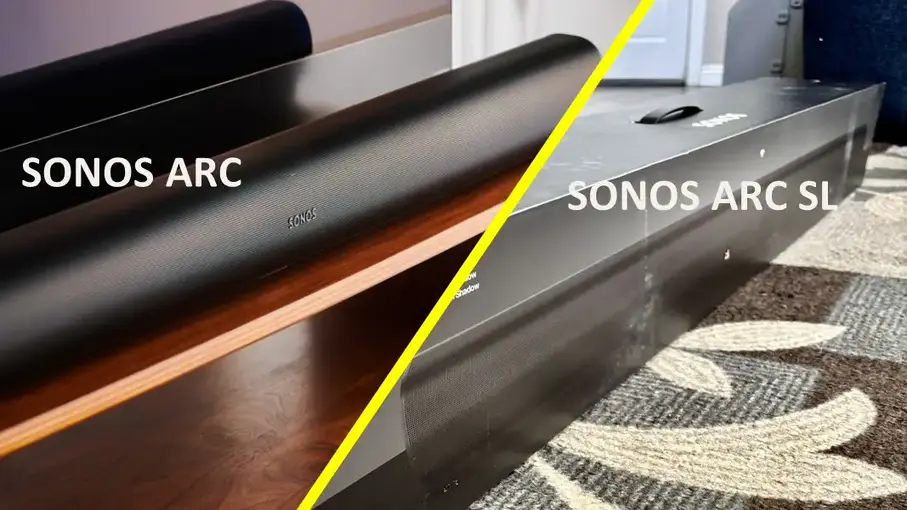
If you’re torn between the Sonos Arc vs Arc SL, you’re likely weighing a decision that comes down not to audio performance, but to privacy and smart features. Both soundbars deliver immersive 5.0.2-channel Dolby Atmos audio using the same set of 11 precision-tuned drivers and identical hardware, making either model an excellent choice for movies, TV shows, or high-fidelity music in mid-to-large living spaces. However, depending on your openness to voice assistants like Alexa and Google Assistant—or your desire to avoid built-in microphones—the difference becomes meaningful.
This in-depth comparison is crafted by analyzing technical reviews, expert commentary, and customer feedback from leading publications and communities. Whether you’re planning a minimalist 3.0 living room setup or expanding into a 5.1.2 surround system using Sonos Sub and Era 300 speakers, this breakdown helps you understand the practical differences between these two high-performance soundbars. Read on as we dive into the detailed specs and feature analysis for a clear picture of which one aligns with your needs.
Sonos Arc vs Arc SL Specs Comparison
| Features | Sonos Arc | Sonos Arc SL |
|---|---|---|
| Dimensions (W x H x D) | 25.63 x 2.68 x 3.94 in | 25.63 x 2.68 x 3.94 in |
| Weight | ~4.19 lbs (1.9 kg) | ~6.35 lbs (varies by source) |
| Driver Configuration | 11 drivers (8 woofers, 3 tweeters) | 11 drivers (8 woofers, 3 tweeters) |
| Supported Audio Formats | Dolby Atmos, TrueHD, Dolby Digital | Dolby Atmos, TrueHD, Dolby Digital |
| Dolby Atmos Channels | 5.0.2 | 5.0.2 |
| Microphones | Built-in (far-field, with voice control) | None (“Speechless” design) |
| Voice Assistant Support | Amazon Alexa, Google Assistant | None (may control via app or other device) |
| Trueplay Tuning | Yes (iOS device or external mic required) | Yes (external mic/iOS needed) |
| HDMI eARC | Yes | Yes |
| Wi-Fi / Ethernet | Yes / Yes | Yes / Yes |
| Bluetooth | No | No |
| Color Options | Black | Shadow Edition (dark gray) |
The features listed above highlight the main differences. For complete specifications and the latest details, refer to the Amazon product pages for Sonos Arc and Sonos Arc SL.
Detailed Feature Comparison
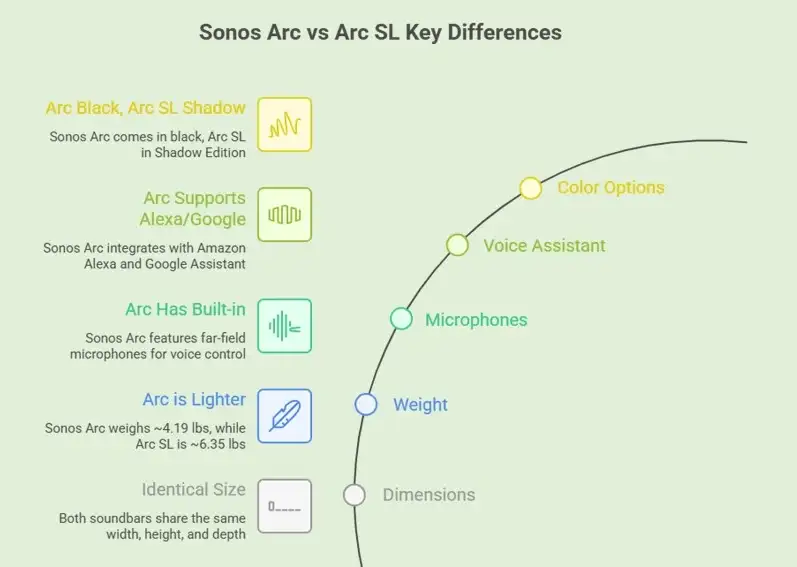
Microphone and Voice Assistant Integration
Sonos Arc: The Sonos Arc features far-field microphones that support voice interaction via Amazon Alexa or Google Assistant. This makes it a practical choice for smart homes, where hands-free operation is key. You can adjust volume, control playback, ask for weather updates, or manage other connected devices with your voice. While convenient, always-on mics have sparked privacy concerns for some users. Regardless, if you’re looking for built-in voice control without an extra device, the Arc offers full functionality natively.
Sonos Arc SL: The “SL” in Arc SL stands for “speechless,” and that’s exactly what defines this version: no built-in microphones. As a result, the Arc SL cannot natively use Google Assistant or Alexa—although it can still be controlled via the Sonos app or other mic-enabled Sonos speakers. This variant is tailored for privacy-conscious buyers or households that already have voice assistants in other devices (like an Echo Dot). It’s important to note that the absence of mics does not impact sound quality or performance.
Design and Aesthetics
Sonos Arc: The Arc carries the standard black Sonos design language, with a slightly glossy finish and visible Sonos branding. Built for placement under large TVs, it integrates well with most contemporary living room aesthetics. The perforated grille wrap gives it a modern and high-end feel. For buyers seeking consistency with other Sonos components or modern furniture, the Arc’s appearance is in line with the brand’s signature look. However, it may stand out more than its SL equivalent due to its branding and finish.
Sonos Arc SL: The Arc SL offers a darker “Shadow Edition” colorway with a more subtle logo, making it visually stealthier in darker or more minimalistic rooms. While physical dimensions and materials remain consistent with the standard Arc, the muted finish may appeal to users who prefer tech gear to blend into the background. This makes the Arc SL a better visual fit in sleek or home theater-centric environments, particularly when paired with blacked-out TVs or AV racks.
Smart Home Compatibility
Sonos Arc: With native voice assistant integration, the Arc acts as both a soundbar and a smart speaker hub. Users can directly operate smart lights, thermostats, or media through built-in voice commands. This makes it a compelling single-device solution for those built into either Amazon or Google ecosystems. If seamless IoT and voice control is a priority, Arc enhances daily usage by removing the need for multiple devices or apps to control smart features.
Sonos Arc SL: While it doesn’t include a microphone, the SL can still participate in a smart home setup when combined with another voice-enabled Sonos speaker. Via the app or partner devices, users retain indirect control over smart functionality, but not through the soundbar itself. This setup may require some additional networking or layering if full integration is desired. That said, many users who already use smart assistants on their phones or through smart hubs won’t be restricted.
Included Accessories and Connectivity
Sonos Arc: The Arc typically includes an HDMI eARC cable, power cable, and an optical audio adapter, making it easier to set up with a wider range of TV models including those lacking eARC ports. This added flexibility in port options eases installation challenges and supports more TV brands out-of-the-box. Lack of Bluetooth remains a downside for some wireless users, but HDMI and Wi-Fi remain the core connection paths for optimal lossless audio.
Sonos Arc SL: Reports indicate that some models of the Arc SL may not include the optical audio adapter in the box, which could complicate setup for users with older TVs. Functionally, the SL shares the same HDMI eARC port and wired/wireless network capabilities, so performance isn’t limited—just potential convenience. Prospective buyers should verify what’s included in their region, especially if they rely on optical inputs. The omission reflects a slight cost-trimmed packaging approach.
Price and Value Consideration
Sonos Arc: As the full-featured variant, the Arc typically sits at a higher price point—about $150 more than the Arc SL—due to its built-in voice assistant functionality. For some users, this addition more than justifies the extra investment, particularly if it’s the centerpiece of a voice-controlled home. However, if voice control is unused, that premium may feel unnecessary in a tightly budgeted setup.
Sonos Arc SL: Offered at a more affordable price point, the Arc SL delivers the same premium audio performance minus the integrated mics. This makes it one of the better values in the premium Dolby Atmos soundbar market for non-voice assistant users, especially when paired with a Sonos Sub or surround speakers. Budget-conscious buyers willing to sacrifice smart integration for savings often prefer the Arc SL.
Sonos Arc vs Arc SL, Customer Review Analysis
Sonos Arc
Customer feedback for the Sonos Arc is largely positive, with high praise for its immersive Dolby Atmos support and seamless integration with the broader Sonos ecosystem. Many users love how the Arc dramatically improves TV audio, especially in open-concept or large living rooms. Reviewers frequently mention its sleek design and voice assistant integration as standout features. On Amazon and Best Buy, long-term owners commend the build quality and consistent firmware updates. However, some users report issues with eARC compatibility on older TVs, and a few note connectivity drops during HDMI-CEC commands. A consistent critique is the premium pricing and the lack of HDMI passthrough. That said, reliability over time appears strong with few major durability issues reported after extended use.
Sonos Arc SL
The Sonos Arc SL is appreciated by those who value privacy and don’t mind the absence of built-in microphones. Customers who purchased it from outlets like Costco often cite its value-driven pricing and minimalistic appeal. User reviews highlight identical audio performance compared to the standard Arc, making it a favorite among home theater enthusiasts who already use external voice assistants or prefer not to use them at all. Despite the overall satisfaction, some buyers express disappointment at the lack of communication about the missing voice control—especially if they bought it without understanding the “SL” stands for “speechless.” The Arc SL’s long-term performance is reported as stable, mirroring the Arc in firmware support and reliability. Still, buyers should note that the SL is sometimes harder to find since it’s retail-limited or bundled in select packages.
| Common Praise | Common Complaints | |
|---|---|---|
| Sonos Arc | Immersive sound, Dolby Atmos support, smart assistant integration, solid build quality | High price, HDMI-eARC issues on older TVs, no HDMI passthrough |
| Sonos Arc SL | Same audio as Arc, good value for privacy-focused users, clean design | No voice assistant, less widely available, lack of clear product labeling |
Sonos Arc vs Arc SL, Use Case Analysis
When to Choose Sonos Arc
- You want hands-free voice control via Alexa or Google Assistant built-in.
- Your setup includes other smart home or IoT products integrated through voice commands.
- You have a large to mid-size living room and want robust Atmos performance.
- You prioritize ease of use with automatic calibration via Sonos Trueplay.
When to Choose Sonos Arc SL
- You prioritize privacy and prefer not to have external microphones or voice assistants.
- You already use a separate device (like an Echo or Nest Hub) for voice commands.
- You’re looking to save on cost without sacrificing sound quality.
- You prefer a clean, minimal aesthetic without extra tech layering.
When to Skip Both
- Your room is very small (under 150 sq ft) and doesn’t warrant a large soundbar investment.
- Your TV setup lacks eARC or ARC support and you rely on multiple HDMI passthrough devices.
- You’re outside the Sonos ecosystem and prefer traditional receivers or soundbar-subwoofer combos.
- Your budget is below mid-tier pricing—both models are premium-level audio devices.
What the Experts Recommend Sonos Arc SL vs Arc
Experts from RTINGS, What Hi-Fi, and Reviewed generally recommend the Sonos Arc as the more versatile and feature-rich option, especially for users who want voice assistant integration. RTINGS highlights its superior performance in spacious living environments, emphasizing its clear center channel for dialogue. What Hi-Fi appreciates the SL variant for its identical acoustic design and praises it for systems where voice input isn’t needed. Reviewed notes the Arc is ideal for users already using Alexa or Google Assistant daily and emphasize its user-friendly software interface. The Arc SL, meanwhile, is often recommended for privacy-conscious users or secondary setups.
| Review Site | Recommended Speaker | Reason |
|---|---|---|
| RTINGS | Sonos Arc | More features, better for home theater, excellent surround performance |
| What Hi-Fi | Sonos Arc SL | Same audio quality, ideal for private setups with no voice assistant need |
| Reviewed | Sonos Arc | Voice control plus app integration offers a better smart setup experience |
Why Experts Recommend Sonos Arc
Most experts recommend the Sonos Arc for users who value voice assistant integration and a full feature set. It’s considered one of Sonos’ most complete soundbars, offering rich, room-filling sound with Dolby Atmos and advanced calibration. RTINGS, in particular, applauds its impressive soundstage and center channel detail, making it a go-to choice for movie and TV dialogue clarity. The Arc is ideal for modern smart homes where automation and voice command convenience matter.
Why Experts Recommend Sonos Arc SL
Experts appreciate that the Sonos Arc SL delivers the same premium audio at a slightly lower price, which makes it ideal for secondary rooms or users looking to avoid always-on microphones. What Hi-Fi calls it a “smart compromise” for buyers who don’t engage with voice assistants but still want immersive, high-quality sound. It’s often positioned as the better choice for privacy-focused households or home theater purists already using external smart devices.
Conclusion
In the Sonos Arc vs Arc SL comparison, each soundbar serves a clear purpose: the Sonos Arc suits users who want built-in voice assistant features, while the Sonos Arc SL is ideal for privacy-conscious users or those already using third-party smart assistants. Both deliver the same high-fidelity, Dolby Atmos-enabled sound and integrate smoothly into a Sonos multi-room ecosystem. Choosing between them often comes down to personal tech preferences and budget flexibility. By understanding your usage habits, room layout, and comfort with smart features, you can confidently pick the model that best aligns with your needs, without compromising on audio quality.
What is the difference between Sonos Arc and Sonos Arc SL?
The Sonos Arc SL removes all built-in microphones, meaning it lacks voice assistant support, while the standard Arc includes Alexa and Google Assistant integration. Sound quality and design are otherwise identical.
Is the Sonos Arc SL as good as the Sonos Arc?
Yes, in terms of audio performance, the Arc SL is identical to the Sonos Arc. The only difference is the absence of voice control features.
Which is better: Sonos Arc or Sonos Arc SL?
“Better” depends on your needs. Choose the Arc if you want voice assistant features; go with the Arc SL if you prefer privacy and don’t need a mic.
Does the Sonos Arc SL support Dolby Atmos?
Yes, the Sonos Arc SL supports Dolby Atmos, just like the standard Sonos Arc.
Can I add a subwoofer to the Sonos Arc or Arc SL?
Yes, both the Sonos Arc and Arc SL support optional Sonos Sub or Sub Mini integration for enhanced bass performance.