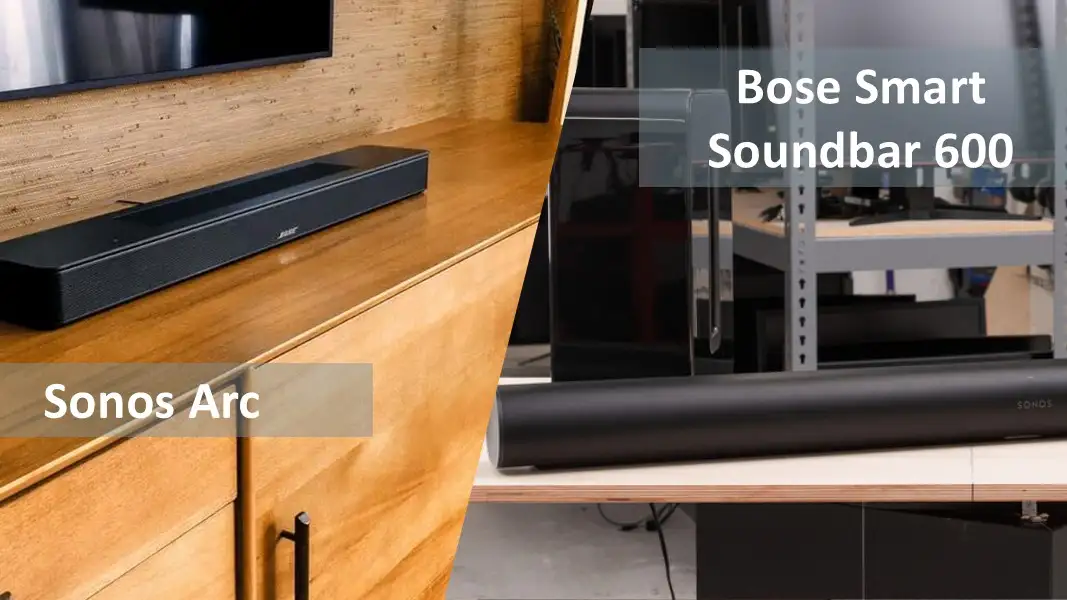
If you’re in the market for a premium Dolby Atmos soundbar, comparing the Sonos Arc vs Bose 600 is a smart place to start. These two soundbars cater to users seeking cinematic audio without the complexity of a full home theater system. Whether you’re outfitting a compact living room or building an immersive setup for a 70+ inch TV, these models represent two distinct takes on soundbar performance in 2024.
Drawing from a detailed analysis of expert reviewers, technical specs, and ongoing community sentiment, this article breaks down how the Sonos Arc and Bose Smart Soundbar 600 stack up across real-world usage — from watching Dolby Atmos-enabled movies to listening to dynamic music or enhancing quiet dialogue on talk-heavy shows. We’ll also explore how each model performs in different room sizes, what kind of connectivity and voice assistant support they offer, and how expandable they are within their respective ecosystems.
This impartial comparison is built on hands-on testing insights from reputable sources and real user feedback, providing an evidence-backed overview for anyone serious about buying the right soundbar for their needs.
Specs Comparison Table: Sonos Arc vs Bose 600 Soundbar Specs
| Features | Sonos Arc | Bose Smart Soundbar 600 |
|---|---|---|
| Dimensions (H x W x D) | 116 x 1142 x 87 mm | 56 x 694 x 104 mm |
| Weight | 6.25 kg | ~3.4 kg |
| Channel Configuration | 5.0.2 (3 tweeters, 8 woofers) | 5.0.2 (5 total drivers) |
| Upward-Firing Speakers | 4 total (height + surround) | 2 total |
| Audio Formats Supported | Dolby Atmos, TrueHD, Dolby Digital+ | Dolby Atmos, Dolby Digital+, TrueSpace upmixing |
| Connectivity | HDMI eARC, Optical, Ethernet, Wi-Fi (802.11n) | HDMI eARC, Optical, Ethernet, Wi-Fi (802.11n), Bluetooth 5.0 |
| Bluetooth | No | Yes |
| Voice Assistant Support | Sonos App, Sonos Voice Control | Alexa and Google Assistant built-in |
| Room Calibration | Trueplay (iOS device required) | EQ tuning + TrueSpace (no dedicated calibration) |
| Expandability | Supports Sub Mini, Era 100/300 for surround | Supports Bass Module 500, surround speakers |
| Multi-Room Streaming | Sonos Multi-room ecosystem | Spotify Connect, Chromecast, AirPlay 2 |
These are the key features. For detailed specifications and updates, refer to the official websites of the Sonos Arc and Bose 600 soundbar.
Detailed Feature Comparison
Dolby Atmos Performance
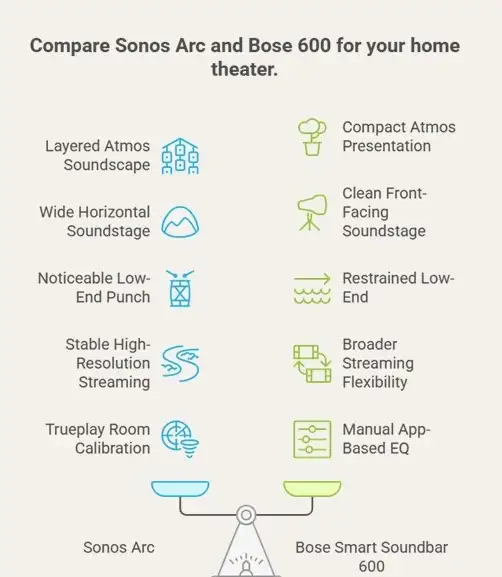
Sonos Arc: The Sonos Arc boasts four upward-firing and side-firing drivers dedicated to delivering spatial effects. This design creates a more layered and expansive Atmos soundscape. Real-world feedback from home theater enthusiasts highlights its ability to project height effects more convincingly than many competitors, especially in medium to large rooms. Combined with Trueplay room calibration, the Arc adapts well to your environment, optimizing 3D audio reflections off ceilings and walls.
Bose Smart Soundbar 600: The Bose 600 features two upward-firing drivers and deploys digital TrueSpace processing to simulate surround and height channels. While the physical drivers do provide noticeable vertical audio effects, the overall experience is less enveloping than the Arc’s. Still, in smaller rooms or apartments with lower ceilings, the Bose often delivers an impressive Atmos presentation considering its compact size and driver count.
Soundstage and Immersion
Sonos Arc: The Arc is designed to create a wide, horizontal soundstage thanks to its side-firing drivers and multi-speaker array. Reviewers often praise its ability to fill space with directional effects, giving the impression of surround sound even as a standalone unit. It tends to shine in spacious living rooms, offering cinematic immersion for both movies and orchestral music.
Bose Smart Soundbar 600: Despite its compact form factor, the Bose 600 produces a clean and detailed front-facing soundstage. However, the lack of side-firing speakers means it doesn’t achieve the same wraparound effect as the Arc. For viewers seated directly in front of the TV, dialogue and action feel centered and engaging, though lateral width is somewhat limited.
Bass Response (Standalone)
Sonos Arc: With eight internal woofers, the Arc delivers noticeable low-end punch even without an external subwoofer. Its low-frequency response gives action scenes and bass-heavy music added depth, making it suitable for immersive playback out of the box. While pairing it with the Sonos Sub enhances impact, many users find the standalone bass more than adequate in medium-sized rooms.
Bose Smart Soundbar 600: The Bose 600 produces a cleaner yet more restrained low-end. Mid-bass is present and well-controlled, particularly for dialogue-heavy content like sports and TV shows. However, when it comes to cinematic explosions or EDM tracks, the soundbar lacks the physical rumble or depth found in the Arc. Bass enthusiasts may find a Bose Bass Module essential for a fuller experience.
Connectivity and Streaming
Sonos Arc: Sonos prioritizes stable, high-resolution streaming through Ethernet and Wi-Fi but omits Bluetooth connectivity entirely. This means users are limited to the Sonos app ecosystem or AirPlay 2 for wireless playback. While seamless within the Sonos ecosystem — including true multi-room audio — the lack of direct Bluetooth may hinder quick connections or guest users in some scenarios.
Bose Smart Soundbar 600: With Bluetooth 5.0, Chromecast built-in, AirPlay 2, and Spotify Connect, the Bose 600 offers broader streaming flexibility. This allows for direct pairing from smartphones and tablets without third-party apps. Users who stream music from various services or prefer multi-assistant setups will likely appreciate the flexibility and convenience here.
Room Calibration
Sonos Arc: Trueplay tuning — accessible via iOS devices — analyzes the room’s acoustics and adapts the Arc’s output accordingly. This feature often improves clarity and spatial realism, especially in irregular room layouts or acoustically challenging spaces. However, its limitation to Apple devices reduces accessibility for Android users.
Bose Smart Soundbar 600: Bose uses TrueSpace processing and manual app-based EQ adjustments rather than a formal room calibration system. While this provides some level of tuning flexibility, it lacks the room-specific acoustic precision that Trueplay delivers. As a result, sound optimization is more generalized and may not adapt as dynamically to unique environments.
Sonos Arc vs Bose 600, Customer Review Analysis
| Sonos Arc | Bose Soundbar 600 | |
| Amazon Rating | 4.5/5 (1,519 global rating) | 4.2/5 (187 global rating) |
| 5 star | 81% | 64% |
| 4 star | 7% | 15% |
| 3 star | 4% | 7% |
| 2 star | 1% | 5% |
| 1 star | 7% | 9% |
Sonos Arc
Across major marketplaces like Amazon and Best Buy, the Sonos Arc earns consistently strong ratings, often praised for its immersive Dolby Atmos performance, rich bass, and seamless integration into the Sonos ecosystem. Customers frequently comment on the sleek design and strong build quality, with many appreciating the software-based room tuning (Trueplay) that tailors the sound to their space.
Several users mention frustration around the lack of HDMI passthrough, which can limit connectivity flexibility. Some also point out that optimal performance requires a fairly large room, and those with smaller setups may find it overpowering. Long-term reliability is usually rated highly, though compatibility with non-Sonos systems or setups requiring analog inputs is limited. Owners who already use other Sonos products appear more satisfied due to the ecosystem benefits.
Bose Smart Soundbar 600
Customers reviewing the Bose Smart Soundbar 600 often highlight its compact size, versatile streaming options, and Dolby Atmos support at a mid-range price point. Many appreciate Bose’s Voice4Video and built-in Alexa/Google Assistant, calling it great for everyday mixed use TV, streaming, and voice commands. The sound quality receives generally positive feedback, especially considering the speaker’s size, although some users feel the Atmos effect is subtle compared to larger competitors.
Common concerns include occasional connectivity drops with Wi-Fi or Bluetooth and less impactful bass when used without the subwoofer. Long-term users note Bose’s software stability as a plus, but express concern that firmware updates occasionally create compatibility hiccups. Its integration with the broader Bose ecosystem is also seen as more limiting than Sonos.
| Common Praise | Common Complaints | |
|---|---|---|
| Sonos Arc | Immersive Atmos sound, strong Sonos ecosystem support, premium build | Lacks HDMI passthrough, may be too powerful for small spaces |
| Bose Smart Soundbar 600 | Compact design, solid smart features, good sound for its size | Limited bass without a subwoofer, subtle Atmos effects, occasional connectivity issues |
Sonos Arc vs Bose 600, Use Case Analysis
When to Choose the Sonos Arc
- You have a large or open-concept living space and want expansive surround sound.
- You already use Sonos products and want full integration via the Sonos app.
- You prioritize Dolby Atmos height effect and want cinematic audio without satellite speakers.
- Your TV setup supports eARC, minimizing connectivity limitations of the Arc.
- You’re comfortable paying for premium audio and build quality.
When to Choose the Bose Smart Soundbar 600
- You want an affordable smart soundbar with balanced performance and voice assistant support.
- Your room is small to medium-sized where large soundbars may be overpowering.
- You prefer native Alexa and Google Assistant integration for everyday commands.
- You may add optional Bose speakers in the future but want to start with a compact core system.
- You’re looking for simple setup and plug-and-play compatibility across most TVs.
When to Skip Both
- You want full HDMI passthrough or have complex device chains—neither speaker supports it robustly.
- You’re strictly budget-sensitive and only need basic TV audio improvement under $250.
- You need analog inputs or support for older devices like legacy DVD players or game consoles.
- You have highly specific soundstage requirements (e.g., for music mixing) that need discrete channels.
What the Experts Recommend? Sonos Arc vs Bose 600
Expert reviews from trusted sources reveal a split opinion depending on priorities. RTINGS recommends the Sonos Arc for its better Dolby Atmos implementation and soundstage, particularly in large rooms. What Hi-Fi praises the Arc’s immersive audio and room-filling performance but acknowledges the Bose 600’s value and feature set for smaller environments. Reviewed.com emphasizes that the Bose 600 is easier to place and manage in compact setups, offering more practicality. Most specialists suggest the Sonos Arc for serious home theater users, while the Bose 600 is a smart choice for those who need a versatile, everyday audio solution without complicating their setup.
| Review Site | Recommended Speaker | Reason |
|---|---|---|
| RTINGS | Sonos Arc | Superior Atmos effects and better overall surround performance |
| What Hi-Fi | Sonos Arc | High-fidelity, room-filling sound; ideal for cinematic experiences |
| Reviewed.com | Bose 600 | Compact design, practical features for smaller homes |
Why Experts Recommend the Sonos Arc
Experts agree that the Sonos Arc delivers exceptional audio fidelity and Dolby Atmos immersion, making it especially well-suited for home theater enthusiasts. It’s particularly praised for its wide soundstage and upward-firing speakers, which add height perception to supported content. Integration with the Sonos ecosystem, along with room-calibration features like Trueplay, further enhances overall sound quality. Despite its higher cost, many consider it a long-term investment for premium home audio.
Why Experts Recommend the Bose Smart Soundbar 600
The Bose Smart Soundbar 600 is favored by reviewers for its blend of features, ease of use, and reasonable pricing. Its support for Dolby Atmos in a compact frame appeals to users in smaller spaces or apartments. Voice assistant integration, Wi-Fi streaming support, and wireless expandability make it a solid choice for users prioritizing convenience and everyday utility, even if it doesn’t fully match the acoustic range of the Arc.
Conclusion
In the Sonos Arc vs Bose 600 comparison, each soundbar caters to a clear user profile. The Sonos Arc is ideal for users seeking high-performance Atmos sound in large or acoustically bright spaces, particularly if you’re already invested in the Sonos ecosystem. Conversely, the Bose Smart Soundbar 600 offers a well-rounded experience for smaller spaces, favoring users who value smart voice features and simplified setup. Both models uphold strong reliability and are backed by reputable brands. Choosing based on your room size, ecosystem preference, and content habits will ensure you get the best return on your investment. This objective breakdown of the Sonos Arc vs Bose 600 soundbar aims to support a confident and informed decision.
Sonos Arc vs Bose 600 soundbar, which is better?
It depends on your setup. The Sonos Arc offers better surround performance and Atmos immersion, while the Bose 600 is more compact and uses smart features effectively in smaller spaces.
Does the Sonos Arc support HDMI passthrough like the Bose 600?
No, neither soundbar supports HDMI passthrough. They both rely on eARC or ARC input and offer limited port options for advanced setups.
Which soundbar is louder: Bose 600 or Sonos Arc?
The Sonos Arc is louder and has a wider soundstage, making it more suitable for large rooms or projector-based home theaters.
Can I expand both soundbars with subwoofers or rear speakers?
Yes, both the Bose Smart Soundbar 600 and Sonos Arc support adding wireless subwoofers and rear speakers designed by their respective brands.
Are both speakers compatible with Alexa or Google Assistant?
Yes, both support built-in voice assistants. The Bose 600 offers native integration, while the Sonos Arc supports them through the Sonos app.