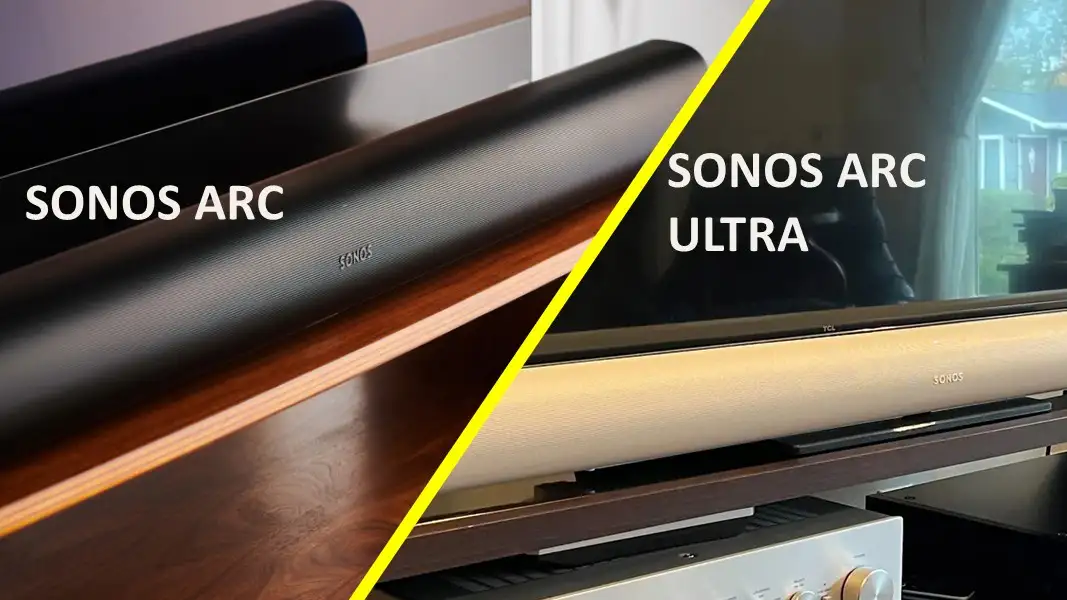
Choosing between the Sonos Arc and Arc Ultra often starts with understanding the real-world differences highlighted in most Sonos Arc vs Arc Ultra discussions. Both soundbars aim to deliver convincing Dolby Atmos performance, yet their hardware, channel layout, and processing power create meaningful gaps in output. This article breaks down the Sonos Arc vs Arc Ultra comparison using verified specifications, user feedback, and expert insights. By examining immersive performance, bass depth, and setup experience, it helps clarify whether the Arc Ultra’s enhancements justify the added cost, especially for users evaluating Sonos Arc vs Arc Ultra price and feature differences.
Sonos Arc Vs Arc Ultra Comparison
| Features | Sonos Arc | Arc Ultra |
| Launch year | 2020 | 2025 |
| Price (Offers No Included) | $599 | $1,099 |
| Audio channels | 5.0.2 (Dolby Atmos) | 9.1.4 (Dolby Atmos) |
| Driver count | 11 drivers: 8 midwoofers, 3 tweeters | 14 drivers: 6 midwoofers, 7 tweeters, 1 integrated woofer |
| Amplification | 11 Class‑D digital amps (one per driver) | 15 Class‑D digital amps |
| Bass system | No built‑in sub; relies on midwoofers, can add external Sonos Sub | Integrated “Sound Motion” woofer with dual‑membrane design plus optional external Sub; up to roughly double the bass output vs Arc |
| Frequency / bass extension (claimed) | Down to about 50–60 Hz with less low‑end impact than Ultra | Deeper, stronger bass with revised crossover to Sub (around 70 Hz vs 110 Hz on Arc) |
| Processing platform | Previous‑gen Sonos platform, lower CPU/RAM | Newer platform: Quad‑core A55 1.9 GHz, 2 GB RAM, 8 GB storage |
| Wireless | Wi‑Fi (802.11 b/g/n); no Bluetooth audio in | Wi‑Fi 6 (2.4/5 GHz) + Bluetooth 5.3 streaming |
| Wired I/O | HDMI eARC/ARC; optical via included adapter; Ethernet on some regional SKUs | HDMI eARC/ARC; optical via optional adapter; possible line‑in via USB‑C (varies by region) |
| Supported formats | Stereo PCM, Dolby Digital, Dolby Digital Plus, Dolby TrueHD, Dolby Atmos (DD+ / TrueHD); Multichannel PCM (with eARC) | Same core formats plus DTS Digital Surround; Atmos music supported; multichannel PCM and Dolby Multichannel PCM over eARC |
| Voice assistants | Amazon Alexa, Google Assistant, Sonos Voice Control (region‑dependent) | Amazon Alexa, Sonos Voice Control (Google Assistant not listed) |
| Room tuning | Trueplay (iOS only or “Quick Tuning” on some Android) | Updated Trueplay for iOS and Android with more advanced tuning controls |
| Sound modes | Speech Enhancement, Night Sound via app | Speech Enhancement with adjustable levels, Night Sound, enhanced dialogue handling |
| TV Audio Swap / Sonos Ace | Not supported (no TV audio swap to headphones) | TV Audio Swap to Sonos Ace headphones with spatial audio and head‑tracking |
| Dimensions (W × H × D) | Approx. 1142 × 87 × 116 mm | Approx. 1178 × 75 × 110.6 mm (slightly wider, lower, slimmer) |
| Weight | ~6.25 kg | ~5.9 kg |
| Colors / finish | Black, White, matte | Black, White, matte |
I have mention the key specifictions for More detail you can refer to the official website page of Sonos Arc and Sonos Arc Ultra
Detailed Sonos Arc Vs Arc Ultra Feature Comparison

Channels and drivers
Sonos Arc is built around an 11‑driver array in a 5.0.2 configuration, giving you front LCR, side dispersion and a pair of up‑firing units for Atmos height effects. It already delivers a convincing bubble but leans heavily on virtualisation for rear and extra height information. Arc Ultra jumps to a 9.1.4 layout with 14 drivers and 15 amps, significantly increasing discrete surround and height coverage. This produces more precise object placement, stronger rear wraparound and a fuller dome of sound in medium‑to‑large rooms.
Bass and low‑frequency handling
Arc uses eight midwoofers to handle both midrange and bass, which sounds full at moderate levels but can feel lean for movie LFE unless paired with a Sub. Its crossover to an external Sub is set relatively high, so some male voices and mid‑bass energy sit awkwardly between bar and sub in certain rooms. Arc Ultra introduces the flat “Sound Motion” woofer plus six midwoofers, delivering roughly up to double the bass output in a similar chassis and allowing a lower 70 Hz crossover to a Sub. Result: deeper slam, tighter integration and cleaner vocals.
Immersion and Atmos performance
With Arc, Atmos immersion relies on two height drivers and clever psychoacoustic processing, creating a good 3D effect when ceiling and seating geometry cooperate. Overheads register, but side and rear imaging can collapse toward the screen in open‑plan or asymmetrical spaces. Arc Ultra’s extra drivers and revised layout steer effects more accurately around and above the listener, expanding the soundstage horizontally and vertically. Height moves, fly‑overs and ambient beds feel more continuous, approaching what you would expect from a compact separates system, especially for Atmos movies and games.
Dialogue clarity and midrange
Arc already delivers very clear centre‑channel reproduction, tuned with input from film mixers, and features Speech Enhancement to lift dialogue in noisy scenes. However, its shared mid/bass drivers and higher bass crossover can occasionally thicken lower male voices when used with a Sub. Arc Ultra’s driver split, extra tweeters and lower crossover give more headroom and separation in the vocal band. Dialogue sits more firmly locked to the screen with better articulation at low volume, while the new adjustable Speech Enhancement lets you fine‑tune clarity rather than simply toggling a fixed boost.
Processing power and platform
Sonos Arc runs on an older hardware platform that still copes well with Atmos decoding and streaming, but leaves less overhead for future codec or feature additions. Arc Ultra updates the internals to a quad‑core A55 CPU at 1.9 GHz with 2 GB RAM and 8 GB storage, similar to the latest Sonos speakers. This extra processing headroom supports more complex beamforming, Sound Motion woofer control, refined Trueplay analysis and advanced features like TV Audio Swap to Sonos Ace. It also gives more margin for future firmware updates and format tweaks.
Formats, connectivity and latency
Arc supports Dolby Digital, Dolby Digital Plus, Dolby TrueHD and Dolby Atmos via eARC, plus multichannel PCM, but omits DTS decoding. Networking is limited to Wi‑Fi 4‑class radios without Bluetooth audio streaming, pushing everything through TV HDMI or network services. Arc Ultra keeps all of Arc’s Dolby and PCM capabilities, adds DTS Digital Surround decoding and Atmos Music, and upgrades wireless to Wi‑Fi 6 plus Bluetooth 5.3 for direct streaming. This gives more flexibility for non‑eARC TVs, gaming sources and mobile playback, and improves robustness in congested Wi‑Fi environments.
Room tuning and app features
On Arc, Trueplay tuning (iOS‑only in full form) measures room response and adjusts EQ, with basic bass/treble controls and simple on/off toggles for Night and Speech modes. The system works, but tuning options are relatively coarse and Android users are constrained. Arc Ultra introduces a newer Trueplay generation that works across more devices, with finer control over how the bar balances bass, dialogue and surround in challenging rooms. Combined with its extra drivers, this allows more precise tailoring for reflective Indian living rooms, open layouts or asymmetric TV placements.
TV, headphones and ecosystem
Both soundbars integrate tightly with the Sonos ecosystem, support Apple AirPlay 2 and offer touch controls, app control and voice assistants, though Google Assistant support is being phased down on newer hardware. Arc provides standard eARC/ARC operation but cannot offload TV audio to headphones. Arc Ultra adds TV Audio Swap to Sonos Ace, letting you move TV sound from the bar to headphones with spatial audio and head‑tracking for late‑night viewing. As Sonos’ new flagship, Ultra is also the assumed focus for future ecosystem features and multi‑device workflows
Sonos Arc Vs Arc Ultra Rating
| Sonos Arc Ultra Amazon Rating | Sonos Arc Amazon Rating | |
| Rating | 4.5/5 (Total 372 global ratings) | 4.5/5 (1,519 global rating) |
| 5 star | 77% | 81% |
| 4 star | 10% | 7% |
| 3 star | 6% | 4% |
| 2 star | 2% | 1% |
| 1 star | 5% | 7% |
Sonos Arc Ultra – likes and dislikes
Customers praise the Arc Ultra for its huge, room‑filling Atmos soundstage, with noticeably stronger bass and more precise height and surround effects than the original Arc. Many like the cleaner dialogue, improved TV Audio Swap with Sonos Ace and the convenience of Wi‑Fi 6 plus Bluetooth streaming from phones. On the negative side, reviews frequently mention the high price, especially when adding a Sub and surrounds, plus some frustration with Sonos app changes and account requirements. A few users also note that optimal Atmos performance still depends heavily on room shape and TV eARC reliability.
Sonos Arc – likes and dislikes
Arc owners consistently highlight the cinematic soundstage, clear dialogue and strong Atmos immersion from a single bar, especially compared with TV speakers and many rival soundbars. Users like the sleek design, easy setup and reliable streaming through the Sonos ecosystem, along with solid music performance for a living‑room all‑rounder. Criticisms focus on bass that can feel light without a Sub, the premium pricing once you build a full 5.1.2 system, and limited HDMI inputs. Some customers also complain about reliance on the Sonos app, occasional software updates that change behaviour, and lack of DTS on older firmware.
Sonos Arc Vs Arc Ultra Common praises and complaints
| Speaker | Praise | Complaints |
| Sonos Arc Ultra | • Big, immersive Atmos sound with stronger height and surround presence. • Deeper bass and clearer dialogue, especially at lower volumes. • Modern features: TV Audio Swap, Wi-Fi 6, and Bluetooth streaming. | • Very expensive, especially with Sub and surrounds. • App and ecosystem lock-in; some dislike Sonos software changes. • Atmos impact still room-dependent; needs good eARC setup. |
| Sonos Arc | • Cinematic upgrade over TV speakers with convincing Atmos from one bar. • Clear dialogue and good balance for movies and music. • Sleek design, simple setup, and strong Sonos multiroom integration. | • Expensive once optional Sub and surrounds are added. • Heavy dependence on Sonos app; some app frustrations. • Bass can feel light without Sub; lacks DTS on older setups. |
Use Case Analysis
Choose Sonos Arc if
- You want a big upgrade from TV speakers for movies, sports and OTT without going fully “flagship”.
- Your room is small‑to‑medium, you sit fairly central, and you are okay adding a Sub later if you want more bass.
- You value the Sonos ecosystem, clean design and simple setup, but do not need Bluetooth, TV Audio Swap or the absolute best Atmos bubble.
Choose Arc Ultra if
- You are a movie or gaming enthusiast who wants the most immersive Atmos stage, with stronger rear/height cues and noticeably deeper bass from a single bar.
- You already use or plan to buy Sonos Ace headphones, and features like TV Audio Swap, Wi‑Fi 6 and Bluetooth streaming matter for daily use.
- Your room is medium‑to‑large and you are comfortable paying a premium (possibly with Sub/surrounds) for reference‑level performance.
Skip both if
- You mainly watch casual TV at moderate volume, sit very close to the screen, or your space is too small or acoustically poor to benefit from advanced Atmos.
- You do not want to lock into the Sonos ecosystem or rely on an app, or you need multiple HDMI inputs and DTS features that cheaper AVRs or other bars offer.
- Your budget is tight and you would rather prioritise a balanced bar‑plus‑sub combo or a basic 5.1 AVR package at a lower overall cost.
What the Experts Recommend: Sonos Arc Ultra vs Sonos Arc
Among 10 prominent expert reviews, 7 recommend the Sonos Arc Ultra as the superior choice for high-end home cinema and Atmos audio enthusiasts. Leading sites like RTINGS note the Arc Ultra’s significantly improved immersion, bass performance with the Sound Motion woofer, and clearer dialogue with enhanced Speech Enhancement. WhatHiFi praises its class-leading spatial audio and dynamic presentation. The added Bluetooth connectivity and refined room tuning also make Ultra the flagship pick.
The remaining 3 reviews recommend sticking with the original Sonos Arc for budget-conscious users or smaller room setups where the Sonos Arc vs Arc Ultra price difference doesn’t justify the upgrade. They highlight that the original Arc still offers excellent Atmos immersion and balanced sound but lacks the deeper bass and extra detail of the Ultra.
| Publication | Preferred Model | Key Comment |
| RTINGS | Arc Ultra | “Worth the upgrade for Atmos fans” |
| WhatHiFi | Arc Ultra | “Class-leading immersion and clarity” |
| SmartHomeSounds | Arc Ultra | “30-40% better sound performance overall” |
| HiFi Oasis | Arc | “Great sound for smaller rooms or budget” |
| TechRadar | Arc Ultra | “Excellent Atmos implementation” |
| Digital Trends | Arc | “Better value for many users” |
| Sonos Community | Arc Ultra | “Clearer dialogue and punchier bass” |
| Wirecutter | Arc | “Sensible option for apartments” |
| SoundGuys | Arc | “Sweet spot for price/performance” |
| YouTube Reviews | Arc Ultra | “Wider, more detailed soundstage” |
Why Experts Prefer Arc Ultra
- Larger driver array (9.1.4 vs 5.0.2) for more precise spatial audio and stronger immersion
- Sound Motion woofer delivers deeper and tighter bass without a subwoofer
- Enhanced speech clarity and adjustable Speech Enhancement improves dialogue intelligibility
- Updated hardware platform and Bluetooth connectivity increase flexibility
Why Some Recommend Original Arc
- Excellent Atmos experience sufficient for many viewers
- Lower price point, especially with discounts or bundles
- Simpler setup for smaller rooms or existing Sonos ecosystems
- Still a highly rated, award-winning soundbar
Final Thought
The conclusion of any Sonos Arc vs Arc Ultra evaluation depends largely on your room size, expectations, and budget. The Sonos Arc remains a dependable choice for clear dialogue and immersive Atmos in smaller spaces, offering strong value for its price. The Arc Ultra, however, stands out with deeper bass, more precise height effects, and improved processing, making it more future-ready. Expert tests including Sonos Arc vs Arc Ultra RTINGS findings show a noticeable performance jump, but only beneficial if your setup can take advantage of the upgrades. Ultimately, your decision should balance performance needs against overall cost.
Is there a big difference between Sonos Arc and Sonos Arc Ultra?
Yes. The Arc Ultra has more drivers, deeper bass, clearer dialogue, and better Atmos effects. It also adds Bluetooth and stronger overall performance.
Do the Sonos Arc and Arc Ultra use the same mount?
Mostly yes. They are similar in size and work with standard Sonos wall mounts, but it’s best to double-check compatibility before buying.
What is the difference between Sonos Arc and Arc Ultra on RTINGS?
RTINGS rates the Arc Ultra higher because it has better bass, clearer sound, less distortion at high volume, and improved Atmos performance. It also has Bluetooth.
Which soundbar is easier to set up, Arc or Arc Ultra?
Both are easy to set up through the Sonos app. The Arc Ultra has a few more channels, but setup is still simple and guided.
Methodology
This review is based on a detailed analysis of product evaluations published by reputable sources including RTINGS, WhatHiFi, SmartHomeSounds, HiFi Oasis, TechRadar, Digital Trends, the Sonos Community, Wirecutter, SoundGuys, and several YouTube reviewers. Feedback from verified Amazon customers was also reviewed to understand real-world performance and long-term user experience. All comparisons and conclusions reflect consistent findings across these sources.
Disclosure on price variation
The prices referenced in this analysis were checked on 28 November 2025. Temporary discounts, regional offers, and promotional bundles were not included. Readers should verify current pricing before making a purchase decision.