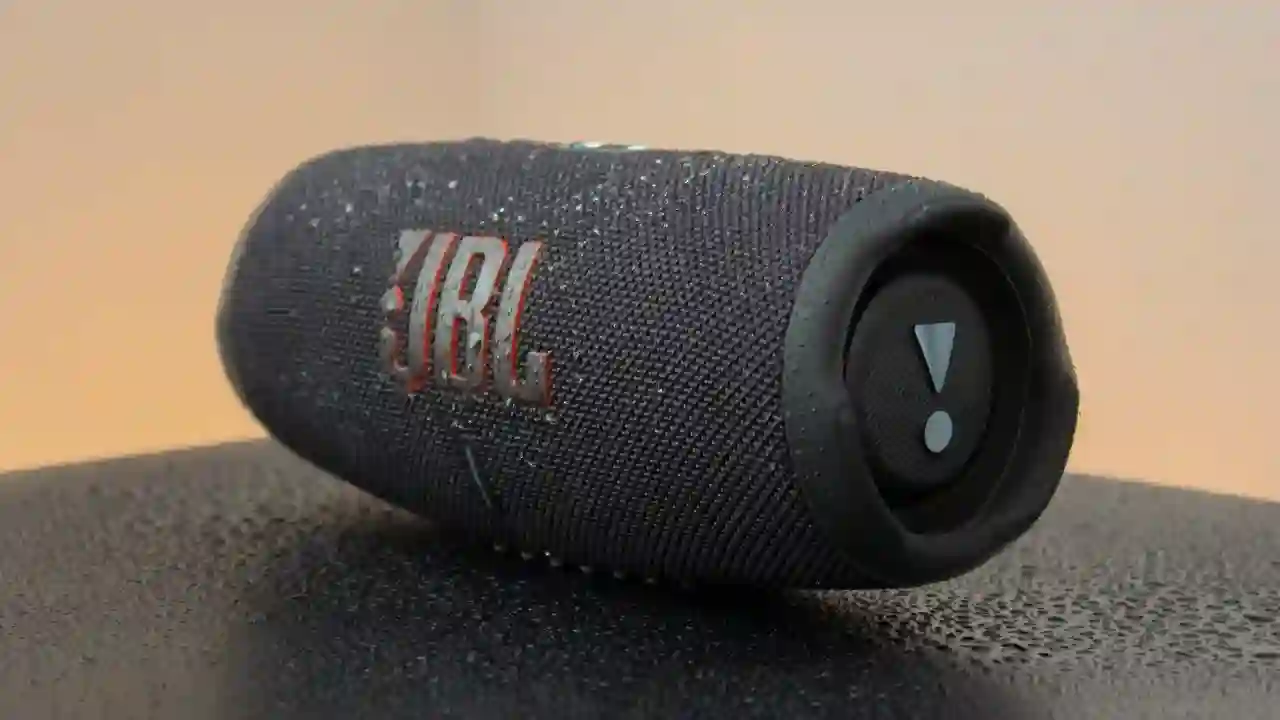
The JBL Charge 5 review examines a rugged portable Bluetooth speaker that doubles as a powerbank and is built for outdoor use. From the start, this product targets people who want loud, bass-forward sound from a compact, travel-ready package and who value water and dust resistance. The speaker brings JBL’s “Original Pro Sound” architecture with a long-excursion woofer, separate tweeter, and dual passive radiators. Battery life is rated up to 20 hours and a USB output allows phone charging on the go.
This review outlines what the Charge 5 does well and where it shows limits. Strengths include IP67 ingress protection, PartyBoost multi-speaker pairing, and a design focused on portability and durability. Limitations include the lack of wired aux or HDMI inputs on the standard model and no confirmed speakerphone or voice assistant features. The article covers specifications, real-world performance across music, movies, gaming, and TV, setup and connectivity, typical owner feedback, competitor comparisons, and practical buying guidance to help decide IS IT WORTH BUYING JBL Charge 5.
JBL Charge 5 Review: Quick Verdict
Best For
People seeking a rugged, portable Bluetooth speaker with strong bass, long battery life, and the ability to charge phones.
Not Ideal For
Those who need wired aux or HDMI connections, voice assistant integration, or low-latency gaming audio.
Top Strengths
IP67 water and dust resistance, up to 20 hours battery life, USB powerbank output, PartyBoost multi-speaker pairing, loud output relative to size.
Biggest Weaknesses
No 3.5mm aux or HDMI inputs on the standard model, no verified microphone/speakerphone functionality, reset and firmware update procedures for the Bluetooth-only model not clearly documented.
Bottom Line
The JBL Charge 5 review shows a capable portable speaker that prioritizes durability and battery convenience. It is a solid pick for outdoor use, poolside listening, and casual party scenarios where portability and bass matter more than advanced connectivity.
Product Overview
The JBL Charge 5 sits in the portable Bluetooth speaker category and targets outdoor and on-the-go listeners. Main highlights include IP67 ingress protection, a built-in powerbank via USB output, up to 20 hours of claimed battery life, PartyBoost for pairing multiple JBL speakers, and an internal design combining a long-excursion woofer, tweeter, and passive radiators for stronger bass. Market positioning places the Charge 5 as an upgrade from the previous generation with improved dust resistance and newer wireless features, appealing to people who want durable, loud sound from a compact package.
JBL Charge 5 Specifications
| Specification | Detail |
|---|---|
| Drivers | 52 mm x 90 mm long-excursion woofer and 20 mm tweeter |
| Passive Radiators | Dual passive bass radiators |
| Total Output Power | 30 W (woofer) + 10 W (tweeter) = 40 W |
| Bluetooth | Bluetooth 5.1 (A2DP 1.3, AVRCP 1.6) |
| PartyBoost | Supported |
| USB | USB Type-C input for charging, USB output (powerbank) 5 V / 2 A |
| Battery Life | Up to 20 hours (manufacturer claim) |
| Charging Time | Approximately 4 hours with 5 V / 3 A charger |
| Water and Dust Resistance | IP67 |
| Dimensions | 223 x 96.5 x 94 mm |
| Weight | 0.96 kg (2.11 lbs) |
| Inputs | No 3.5mm aux, no HDMI (standard model) |
| Wi-Fi | Not on the standard Charge 5 (separate Wi‑Fi variant exists) |
Why These Specifications Matter
The JBL Charge 5 specifications translate directly to everyday use. The driver configuration and passive radiators explain why the speaker can deliver stronger bass and louder output than similarly sized rivals. Bluetooth 5.1 means a modern wireless connection and PartyBoost lets multiple compatible JBL speakers be linked for larger gatherings.
The IP67 rating matters for outdoor use because it protects the speaker from dust and temporary immersion in water, making poolside or beach listening less risky. Battery life and the powerbank output mean the speaker can keep long sessions running and help keep phones topped up during a day out. The trade-offs are clear: to keep the package compact and rugged, JBL left out wired aux and HDMI ports, which limits wired or TV-centric setups.
Key Features Explained
IP67 Water and Dust Resistance
The Charge 5’s IP67 rating protects against dust and allows immersion in up to one meter of water for up to 30 minutes. For anyone planning to use the speaker near pools, beaches, or dusty trails, that rating offers peace of mind. It matters most to outdoor users who need a device that can handle splashes or sandy environments without immediate failure. The limitation is that IP67 covers temporary immersion and dust sealing rather than unlimited submersion or underwater use.
Powerbank Functionality
Having a USB power output turns the speaker into a backup charger. When on a day trip or at an outdoor gathering, the speaker’s battery can supply power to phones or small devices. That dual role increases the speaker’s utility beyond audio. The trade-off is that charging external devices will reduce the speaker’s own runtime, so balancing playback time and device charging is necessary.
Battery Life Up to 20 Hours
JBL rates the Charge 5 for up to 20 hours of playback, which supports full-day use. In practical terms, runtime depends on volume settings and the audio content being played. Louder listening levels and bass-heavy tracks will reduce the real-world runtime. For a compact speaker with powerbank capabilities, that claim supports multi-hour outdoor usage without constant recharging.
PartyBoost Multi-Speaker Pairing
PartyBoost allows the Charge 5 to pair with other PartyBoost-compatible JBL speakers to create a larger sound field in party or stereo modes. This feature helps when a single speaker is insufficient for a larger area. It matters for people who might already own compatible JBL speakers or who want to scale output for events. The limitation is ecosystem compatibility: older JBL products using Connect+ are not compatible with PartyBoost.
Driver Setup and Passive Radiators
The combination of a long-excursion woofer, a tweeter, and dual passive radiators helps the Charge 5 produce punchy bass and clear highs for its size. That tuning benefits listeners who prioritize energetic, bass-forward playback for genres like pop and electronic music. The trade-off is that a single compact unit cannot match the low-frequency depth or stereo imaging of larger multi-driver home systems.
Who Should Buy This
Ideal Buyers
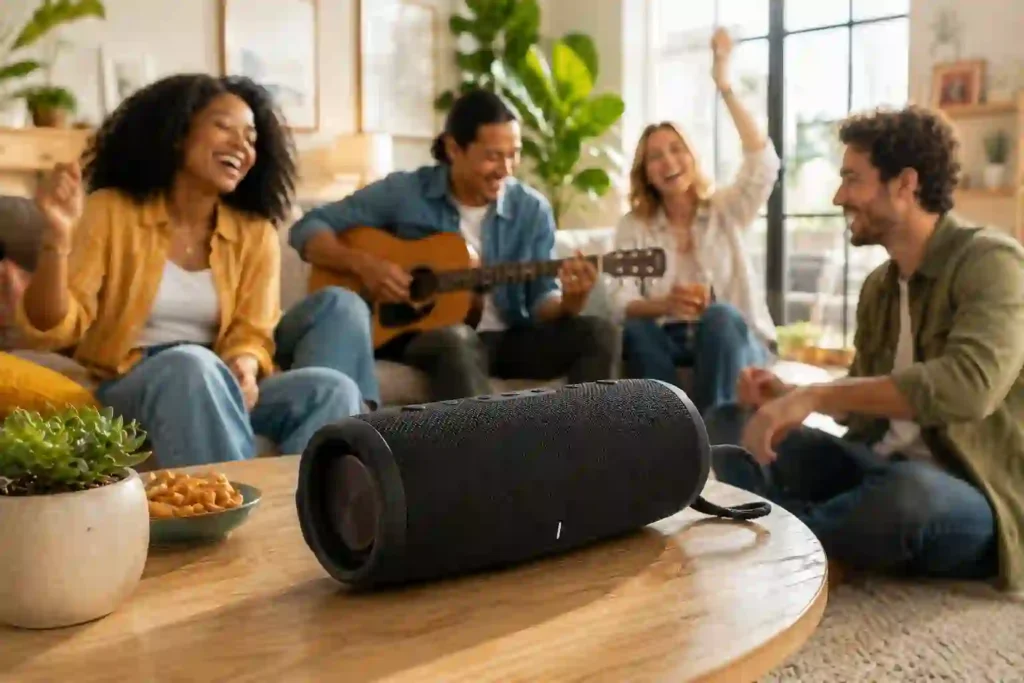
Individuals who spend time outdoors and need a durable, water-resistant speaker that can handle splashes and dust. People who value loud output and punchy bass in a portable form factor. Travelers and day-trippers who appreciate the convenience of a built-in powerbank to charge phones.
Who Should Avoid It
People who require wired connectivity such as 3.5mm aux or HDMI for TV setups. Users who need voice assistant integration, multi-room Wi‑Fi streaming in the standard model, or low-latency audio for competitive gaming. Those who prioritize audiophile-grade stereo imaging and very deep bass may want a larger or different system.
Best Use Cases
Poolside parties, beach days, hikes, picnics, casual outdoor gatherings, and as a portable backup charger for phones.
Less Suitable Use Cases
Primary TV sound replacement for a living room, complex multi-room Wi‑Fi audio setups (standard model), or studio-critical listening where neutrality and precise imaging are required.
Design and Build Quality
The Charge 5 follows a cylindrical, fabric-wrapped aesthetic with rubberized end caps that house visible passive radiators. This finish supports grip and resilience while protecting the drivers and ports. At just under a kilogram, it balances portability and presence. The IP67 rating contributes significantly to durability for outdoor conditions, making it appropriate for sandy beaches or poolside situations.
Materials appear chosen to withstand regular transport and exposure to the elements, while the rubber end caps and fabric wrap give the speaker a familiar JBL look and feel. Mounting features are not included, so the speaker is intended to sit on horizontal surfaces when in use. For placement, a flat surface helps maintain balanced bass and consistent stereo dispersion from the single-unit design.
Setup and Installation
Initial setup is straightforward. Charge the speaker using the included USB Type-C cable and a compatible charger; full charge time is roughly four hours with a 5 V / 3 A supply. Turn the speaker on and pair via Bluetooth 5.1 using standard pairing procedures. For people who want to tweak sound or manage PartyBoost pairing, the JBL Portable app is available for EQ adjustments and multi-speaker control.
The standard Charge 5 does not include Wi‑Fi, HDMI, or a 3.5mm aux input, so setup revolves around Bluetooth and the app. Some users may experience typical pairing confusion when multiple JBL speakers are in range; clearing previous pairings and power cycling both the speaker and source device usually resolve common issues. If you encounter any issues, you can find solutions to these troubleshooting issues in the official user manual of JBL Charge 5.
Real-World Performance
Movies and TV
For casual movie and TV watching, the Charge 5 delivers clear midrange that helps dialogue come through at conversational levels. It is not optimized as a dedicated TV soundbar, so cinematic low-frequency depth and surround immersion are limited. For background viewing and small-room playback, the speaker provides satisfying volume and presence. When positioned near a laptop or portable player for streaming and casual viewing, its loudness and clarity are strengths, while the lack of wired HDMI or optical inputs makes it less suitable as a primary TV audio solution.
Music Listening
Music is where the Charge 5 shows its strengths. The woofer, tweeter, and passive radiators work together to give punchy, present bass that belies the speaker’s size. Vocals are generally clear and sit well in the mix thanks to the tuning described by reviewers. Instrument separation is good for a compact single-unit design, but audiophiles seeking expansive soundstage or deep sub-bass will notice the natural limits. The speaker is loud enough for small gatherings and offers a bass-forward character that suits popular genres such as pop, hip-hop, and electronic music.
Gaming
For casual gaming, the Charge 5 provides immersive volume and impactful effects at moderate levels. However, it is not designed for positional gaming audio; spatial cues are limited by the single-unit configuration. Bluetooth latency is not documented as low-latency or gaming-optimized, so competitive gamers who require minimal audio delay should be cautious. For casual sessions on a phone or tablet, the speaker’s loudness and punch will enhance the experience.
Voice Content and Podcasts
The midrange clarity makes the Charge 5 acceptable for podcasts and voice content. Hosts and dialogue remain intelligible at listening distances suitable for small rooms. For critical listening to long-form spoken-word material, the neutrality of the tuning helps reduce fatigue, though the bass emphasis can occasionally color the experience.
Indoor Use
Indoors, the Charge 5 fills small rooms with clean, energetic sound and is suitable for everyday listening. Stereo imaging is reasonable for a portable single-unit design, but larger rooms will reveal limitations in low-end extension and soundstage width. The speaker performs best as a portable companion or secondary room speaker rather than a dedicated home audio centerpiece.
Outdoor Use
Outdoor use is a core strength. The IP67 rating and robust chassis make the Charge 5 reliable for beach, park, or poolside use. The battery life claim of up to 20 hours supports extended outdoor sessions, although real-world runtime will vary with volume and content. PartyBoost lets the speaker be paired with other compatible JBL units to expand coverage for larger outdoor gatherings.
Best Settings
The JBL Portable app allows EQ adjustments that help tailor the sound to content and environment. For music, a neutral EQ offers balanced vocals and instruments while a modest bass boost suits EDM or hip-hop. For movie watching, slight bass enhancement can add cinematic impact. For late-night listening, reducing bass and overall volume preserves clarity. Since there is no single universally verified preset documented for all content types, experimenting with the app’s presets or custom EQ is the practical approach to finding the Best Sound Setting For JBL Charge 5 that matches individual taste.
Amazon Customer JBL Charge 5 Review Rating
| Stars (4.4/5) | Review (1024 global ratings) |
| 5 Star | 73% |
| 4 Star | 11% |
| 3 Star | 8% |
| 2 Star | 2% |
| 1 Star | 6% |
Why Users Are Giving 4 & 5-Star Reviews
Users give the JBL Charge 5 Wi-Fi high ratings because it combines powerful sound with excellent portability. Many reviewers praise its loud, immersive audio, highlighting the deep, punchy bass, clear vocals, and balanced sound signature that performs well across different music genres. Whether used indoors or outdoors, the speaker consistently delivers clean audio with minimal distortion, making it a favorite for everyday listening and travel.
Another major reason for positive reviews is its rugged design and long battery life. Buyers appreciate the IP67 water and dust resistance, allowing them to use it confidently at the beach, poolside, or on camping trips. The addition of Wi-Fi, Apple AirPlay, Spotify Connect, and stable Bluetooth connectivity provides greater flexibility than traditional Bluetooth speakers. Users also like its compact size, premium build quality, and reliable wireless performance. Although several buyers acknowledge that it is priced higher than competing models, many believe its sound quality, durability, smart connectivity features, and trusted JBL reliability make it a worthwhile long-term investment.
Why Users Are Giving Below 3-Star Reviews
Users who rate the JBL Charge 5 Wi-Fi below three stars generally express disappointment with its smart features rather than its sound quality. Several reviewers mention limitations with the Wi-Fi functionality, noting that the JBL One app requires the speaker and smartphone to be on the same network, preventing convenient remote access. Others also report difficulties setting up or using Alexa, reducing the usefulness of the built-in smart features.
Price is another recurring concern. Some buyers feel the speaker is expensive compared to other portable Bluetooth speakers, especially when certain expected features are missing. The lack of speakerphone functionality for voice calls is frequently mentioned as a drawback, particularly since many competing portable speakers include this feature. A few users also report concerns about product authenticity or warranty registration, leading to dissatisfaction with their purchase. Overall, lower ratings typically come from buyers frustrated by software limitations, missing convenience features, or pricing rather than the speaker’s audio performance, which is generally well regarded.
JBL Charge 5 Competitor Comparisons
JBL Charge 4
When comparing the Charge 5 with the Charge 4, the Charge 5 adds PartyBoost and an improved ingress protection rating. The Charge 5’s IP67 means dustproofing in addition to water resistance, while the Charge 4 used an earlier IPX7 water rating. The newer driver tuning and PartyBoost compatibility make the Charge 5 attractive for people wanting updated features and better ruggedness. Owners with an ecosystem of Charge 4 devices should note that Connect+ and PartyBoost are not compatible, which may influence the decision to upgrade.
JBL Charge 5 Wi‑Fi
The Charge 5 Wi‑Fi variant adds Wi‑Fi connectivity and presents different wireless options in addition to the same driver power. For shoppers who value multi-room audio and Wi‑Fi streaming, the Wi‑Fi model is the better fit. For those who only need portable Bluetooth playback and powerbank features, the standard Charge 5 remains a strong, simpler option.
JBL Charge 6
The Charge 6 represents the next step in the family and brings incremental updates such as newer wireless features and charging improvements. For people who prioritize having the latest generation with potential performance and feature refinements, the Charge 6 could be preferable. For shoppers satisfied with the Charge 5’s balance of sound, battery, and durability, the Charge 5 remains a valid choice.
Ultimate Ears BOOM 3
The Ultimate Ears BOOM 3 is a comparable rugged portable speaker with an IP67 rating as well. Buyers who prefer UE’s app ecosystem and sound signature might choose the BOOM 3. Buyers who prioritize a powerbank output and JBL’s tuning and PartyBoost ecosystem may prefer the Charge 5 instead.
Sony SRS-XB33 and Bose SoundLink Revolve+
These alternatives offer different sound signatures and features such as Extra Bass or 360-degree coverage. The Charge 5 competes by emphasizing bass punch, battery life, and powerbank utility. Shoppers should pick based on preferred sound profile and feature priorities, with the Charge 5 being the practical choice for outdoor durability and integrated charging.
Pros and Cons
Pros
- IP67 water and dust protection combined with a rugged build.
- Up to 20 hours of battery life as claimed by the manufacturer.
- Built-in USB powerbank output to charge phones and devices.
- PartyBoost for pairing multiple JBL speakers.
- Loud output and punchy bass for a compact portable speaker.
- Bluetooth 5.1 for modern wireless connectivity.
Cons
- No 3.5mm auxiliary or HDMI inputs on the standard model.
- No listed speakerphone or voice assistant integration.
- Real-world battery life varies with volume and content.
- Reset and firmware update procedures for the standard Bluetooth model are not clearly documented.
Value for Money
Without current price information, value is best assessed by features and intended use. For people who need a durable, portable speaker that delivers loud volume, punchy bass, long battery life, and the convenience of a powerbank, the Charge 5 offers a compelling feature set. PartyBoost adds future flexibility for those who may expand with compatible JBL speakers. For buyers who require wired inputs, Wi‑Fi multi-room capabilities, or voice assistant features, different models or brands may offer better value depending on priorities.
Final Verdict
The JBL Charge 5 review shows a capable and practical portable speaker that excels in outdoor durability, battery convenience, and loud, bass-forward sound. IP67 ingress protection plus a near one-kilogram build make it comfortable to carry while offering confidence around water and dust. The powerbank feature and up to 20 hours of claimed runtime broaden its usefulness for day trips and gatherings. Limitations are straightforward: no wired aux or HDMI inputs on the standard model, no documented speakerphone or voice assistant features, and limited documentation for reset and firmware processes on the Bluetooth-only variant.
For people prioritizing outdoor use, portability, battery backup, and punchy sound, the Charge 5 is an attractive choice and answers the question IS IT WORTH BUYING JBL Charge 5 for that audience. For those needing TV connectivity, low-latency gaming performance, or integrated smart assistants, other products in the market or the Wi‑Fi variant may be a better fit.
How This Product Was Evaluated
This review examined the speaker’s published specifications, driver layout, connectivity options, IP67 rating, battery and charging details, and PartyBoost functionality. Sound performance observations reflect the speaker’s driver and passive radiator design and typical professional review commentary. Real-world user feedback and common support patterns were considered to present practical strengths and limitations for potential buyers.
Is the JBL Charge 5 waterproof?
Yes. The speaker is IP67 rated, which means it is dustproof and can handle temporary immersion in up to one meter of water for up to 30 minutes.
How long does the battery last on the JBL Charge 5?
The manufacturer rates battery life up to 20 hours. Actual runtime depends on listening volume and the type of audio content.
Can the JBL Charge 5 charge a phone?
Yes. The speaker includes a USB output that operates as a powerbank to charge external devices with a maximum output rating listed in the specifications.
Does the JBL Charge 5 support PartyBoost?
Yes. PartyBoost is supported for pairing multiple compatible JBL speakers in party or stereo modes.
Does the standard JBL Charge 5 have aux or HDMI inputs?
No. The standard Charge 5 does not include a 3.5mm auxiliary input or HDMI ports.
Is there a Wi‑Fi version of the JBL Charge 5?
Yes. JBL offers a separate Charge 5 Wi‑Fi model that adds Wi‑Fi connectivity and different wireless features.
How long does it take to fully charge JBL Charge 5?
Charging time is approximately four hours when using a 5 V / 3 A charger.
What are the best sound setting for JBL Charge 5?
Start with Flat EQ for the most balanced sound on JBL Charge 5. For better all-round music, try Bass +1, Mid 0, Treble +1. For punchier sound, use Bass +2, Mid -1, Treble +1. For vocals and pop, keep mids a little higher and treble around +1 to +2. If bass feels too heavy, reduce bass and keep the EQ close to flat.