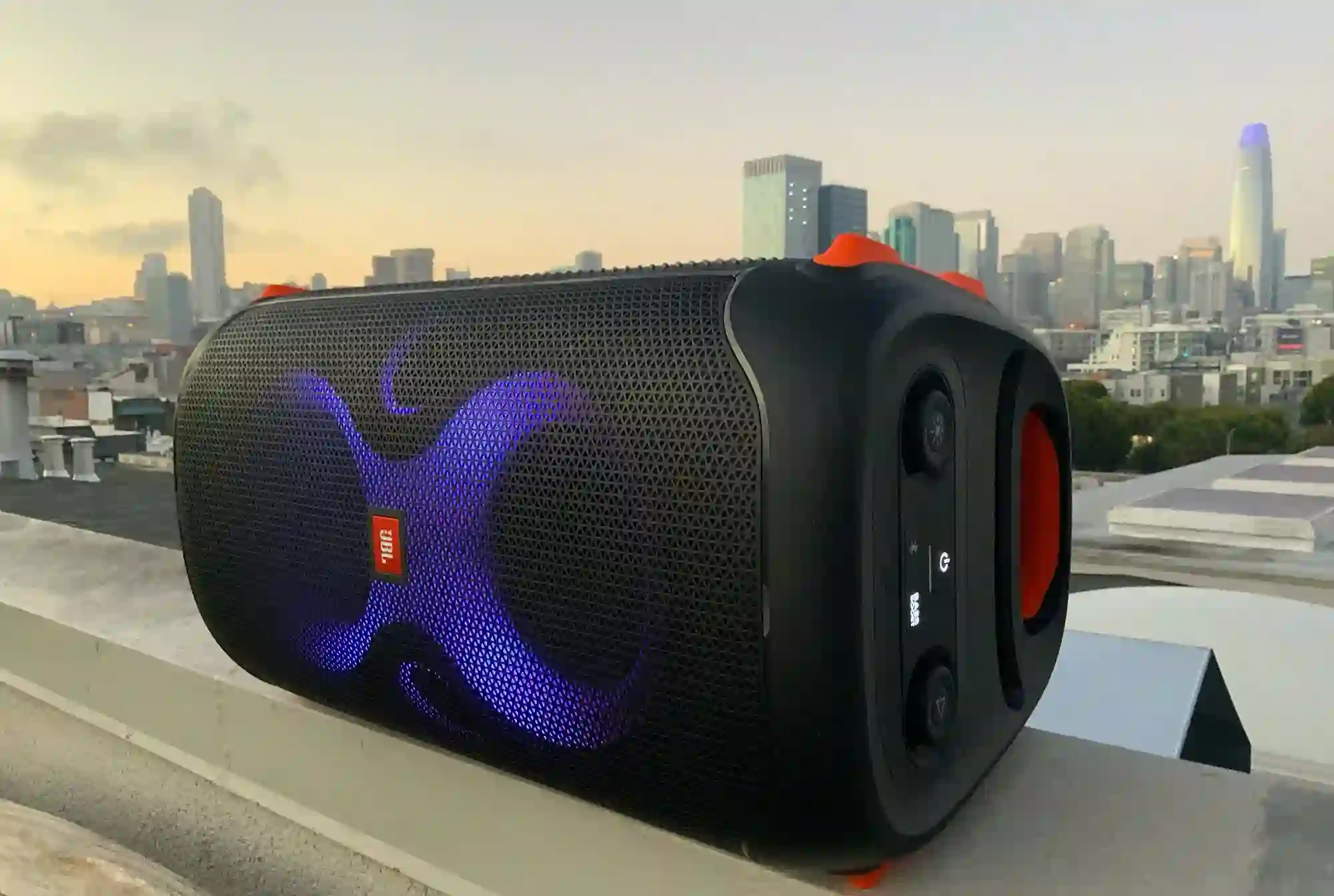
The JBL PartyBox 110 is a portable party speaker designed for people who want loud, bass-forward sound and a built-in light show for casual events. We see it as a speaker aimed at backyard gatherings, small DJ setups, karaoke nights, and anyone who needs a battery-powered loudspeaker with microphone and guitar inputs. Strengths include 160 watts of JBL Original Pro Sound, strong bass response, a dynamic multi-zone LED light show that syncs to music, and a battery that the manufacturer rates at up to twelve hours.
Limitations are its size and weight at about twenty-three pounds and the fact that battery life varies a lot depending on volume and lights. This JBL PartyBox 110 review explains what the speaker does well, where it falls short, the settings to try, who should buy it, and how it compares to other party-class options. By the end readers will know whether the PartyBox 110 matches their needs and how to get the best results from it.
JBL PartyBox 110 Review: Quick Verdict
Best For
People who prioritize loud, party-ready sound with an integrated light show and the option to use a microphone or guitar.
Not Ideal For
Those seeking a lightweight, studio-accurate speaker or a home-theater soundbar with HDMI and surround format support.
Top Strengths
High 160W output and punchy bass; music-synced dynamic LED lighting; convenient mic and guitar inputs; battery-powered portability.
Biggest Weaknesses
Relatively heavy and bulky; real-world battery life drops at high volume and with lights on; bass-forward tuning can sound boomy in small rooms.
Bottom Line
This JBL PartyBox 110 review finds the speaker to be a strong choice for party environments where loudness, bass impact, and lighting matter more than compactness or home-theater features.
Product Overview
The PartyBox 110 sits in the portable party speaker category and targets users who need a battery-powered loudspeaker with show-ready lights. Its main highlights are 160 watts of JBL Original Pro Sound, a multi-zone LED light system that syncs to music, mic and guitar inputs for live use, USB playback and charging, and wireless TWS pairing for stereo setups. Market positioning is squarely in the party and entertainer segment: portable enough to move around with handles and a battery, but large and powerful enough to fill large rooms or outdoor gatherings.
JBL PartyBox 110 Specifications
| Specification | Detail |
|---|---|
| Product Name | JBL PartyBox 110 |
| Brand | JBL Harman |
| Category | Portable party speaker |
| Release Year | 2021 |
| Total Output Power | 160 W RMS |
| Channels | 2.0 stereo |
| Drivers | Two woofers 154.6 mm and two tweeters 55 mm |
| Battery | Rechargeable Li-ion battery rated up to 12 hours |
| Bluetooth | Bluetooth 5.1 |
| Inputs | USB playback and charge-out, AUX 3.5 mm, mic and guitar inputs |
| Water Resistance | IPX4 splash resistant |
| Dimensions | 295 × 568 × 300 mm |
| Weight | 10.84 kg |
WHY THESE SPECIFICATIONS MATTER
When evaluating the JBL PartyBox 110, think about how the specs translate into real use. The 160 watts and dual woofers are why the speaker can reach party-level loudness and deliver the strong bass that makes dance and hip-hop tracks feel energetic. Bluetooth 5.1 gives modern wireless streaming, while the USB playback and charge-out add convenience for events where a phone needs topping up or a USB stick is used for music.
The battery makes the PartyBox portable, but the twelve-hour claim is a manufacturer rating and will shrink when playing loudly or when the LEDs are active. The IPX4 splash resistance offers some protection outdoors but does not mean the unit is waterproof. Finally, the size and weight explain why it is portable for a party speaker but not something to carry long distances comfortably.
Key Features Explained
The loudness and driver setup are central to what the PartyBox 110 delivers. The JBL Original Pro Sound system with 160 watts is designed to produce high SPL and strong bass. That matters at gatherings where the goal is to be heard clearly over people and ambient noise. The trade-off is a tuning that leans bass-forward. This is great for EDM and hip-hop, but in small rooms it can become boomy, so expect to dial back Bass Boost or volume when indoors.
The dynamic LED light show is more than decoration. Multi-zone LEDs around the front and sides sync to music and are configurable via the speaker buttons or the PartyBox app. For people hosting parties, the synchronized lights add atmosphere and remove the need for separate lighting gear. The downside is the increased battery draw when lights are used at high intensity.
Battery-powered operation gives freedom to set up away from AC outlets. The manufacturer rates the battery for up to twelve hours. In practical terms the runtime depends heavily on volume and lights. We recommend treating the battery as a facilitator for portable use while planning to plug in when long runtimes or full-volume performance is required.
Mic and guitar inputs turn the PartyBox 110 into a simple performance tool. Karaoke nights, live announcements, and impromptu performances work well thanks to dedicated front-panel inputs. USB playback adds a convenient local source option and USB charge-out keeps phones alive during events.
TWS pairing and daisy-chain options allow two PartyBox speakers to be paired for wider stereo coverage. For larger events pairing can improve stereo imaging and coverage across a room or outdoor area, though pairing can require following the manual steps precisely to reduce glitches.
Who Should Buy This?
Ideal Buyers
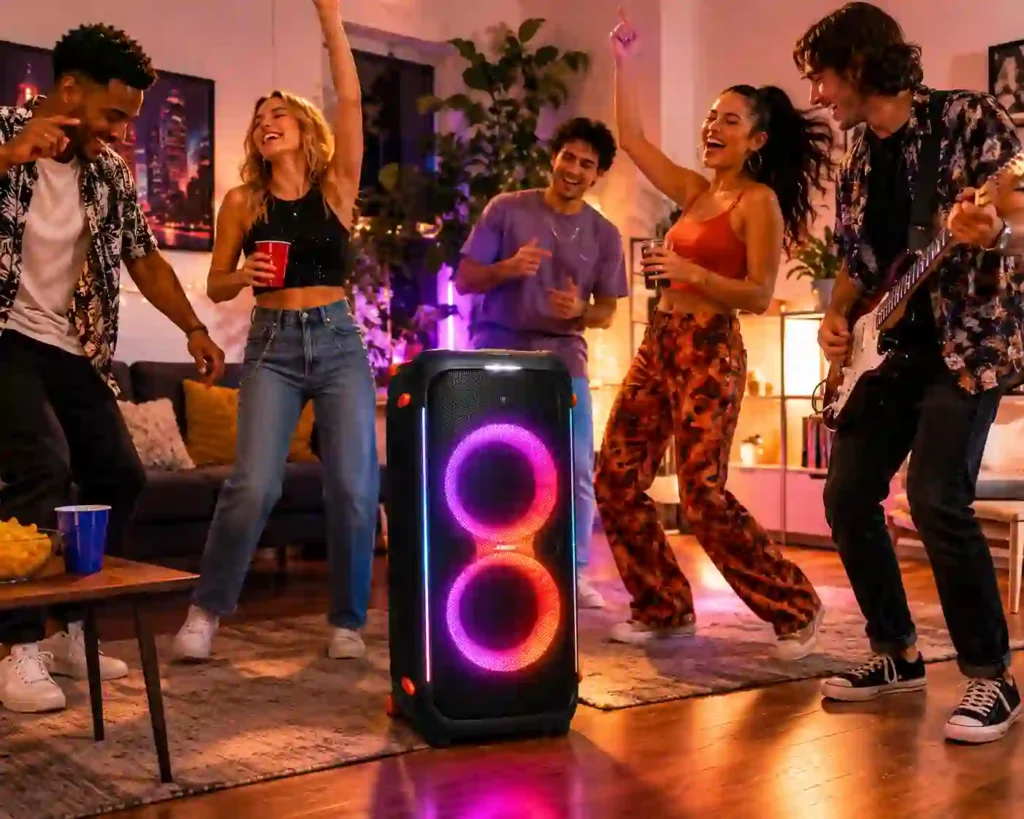
Buyers who want a portable speaker that is loud, bass-heavy, and comes with a built-in light show will find this speaker appealing. It suits backyard party hosts, DJs and entertainers needing mic and guitar inputs, and anyone who wants a show-ready single-box solution for events.
Who Should Avoid It
If a compact, lightweight speaker or a neutral, studio-accurate sound is a priority, this is not the right choice. It is also not suited to buyers who need HDMI connectivity, Wi-Fi, or multichannel home-theater formats like Dolby Atmos or DTS.
Best Use Cases
Outdoor parties, backyard gatherings, karaoke, DJ warm-ups, and events that benefit from a combined audio and lighting presence.
Less Suitable Use Cases
Critical music listening, compact travel use where weight matters, or home-theater setups that require HDMI or surround formats.
Design and Build Quality
Appearance is unmistakably party-oriented. The PartyBox 110 has a black matte textured cabinet with multi-zone RGB LEDs that ring the front and illuminate parts of the fascia. A metal grille protects the drivers and the cabinet feels robust enough for regular transport and outdoor use. Materials are primarily plastic for the cabinet, metal for the grille, and rubberized components around the integrated handles.
Durability is adequate for the speaker’s intended use. The IPX4 splash resistance provides protection against light splashes when ports and flaps are closed, so short-term outdoor use in light rain or near drinks is safer than with no rating. The weight and size make it portable for moving between venues or carrying short distances, but the speaker is not lightweight. Wall mounting is not part of the design and the PartyBox 110 is intended to be set on the floor or a stand.
Placement Considerations
The best way to get punchy bass is to place the PartyBox 110 upright on a stable floor or a low stand. In large rooms or outdoors it can be set to project sound into the audience. In small rooms place it away from corners and reduce Bass Boost to avoid boominess. If pairing two units with TWS, position them opposite each other to widen the stereo image.
Setup and Installation
Setup is straightforward. Charge the speaker, power it on, choose the input, and pair via Bluetooth 5.1 using the Bluetooth button and the device Bluetooth menu. USB playback is plug-and-play for MP3 WMA and WAV files on FAT16 or FAT32 drives. The PartyBox app gives access to light-effect customization, TWS mode, daisy chaining, and factory reset options. No HDMI or Wi-Fi setup is required because those features are not present.
Real-world setup is plug-and-play for most users. For pairing two PartyBox speakers, follow the manual steps carefully, and use a wired connection if Bluetooth interference becomes an issue. Read the official JBL PartyBox 110 user manual for more info.
Sound Performance
Movies and TV
For casual movie watching the PartyBox 110 performs well. Dialogue is generally clear thanks to the present midrange, but this speaker is not a replacement for a home-theater system. Action scenes and explosions benefit from the strong bass and high output, creating an exciting experience. Lack of HDMI and Dolby support limits its role as a TV soundbar.
Music Listening
The speaker shines with party music. EDM, hip-hop, and pop get the most benefit from the bass-forward tuning and high SPL. Vocals stay present in many tracks, and the overall character is lively. For acoustic or vocal-centric music, the tuning can feel heavy in the low end and less refined up top. Instrument separation is fine for casual listening but not detailed enough for audiophile-grade listening.
Gaming
The PartyBox 110 provides immersive, booming sound for cinematic gaming. Its high loudness and bass can enhance explosions and soundtracks. For competitive gaming where positional accuracy and low-latency audio matter, Bluetooth streaming could introduce latency and positional cues are not optimized on this unit. If low latency is important, use a wired AUX connection to reduce wireless delay.
Voice Content and Podcasts
Dialogue and spoken-word content are acceptable for casual listening. When clarity is critical, reducing bass and lowering volume can help voices come through more intelligibly.
Indoor Use
Indoors the PartyBox 110 offers big sound that can overwhelm smaller rooms if settings are not adjusted. Reduce Bass Boost or volume to avoid boominess and place the speaker away from corners. For house parties in medium to large rooms its combination of output and lighting makes it a strong choice.
Outdoor Use
This is where the PartyBox 110 is most comfortable. Outdoors the strong bass and high SPL carry well, and the LED light show adds atmosphere. IPX4 splash resistance helps protect against accidental splashes, but the speaker is not designed for submersion or prolonged exposure to rain.
Best Settings
For movies and dialogue reduce or turn off Bass Boost to improve clarity and avoid muddiness. For party music such as EDM and hip-hop leaving Bass Boost engaged produces the energetic low end most listeners expect. For gaming use a wired AUX connection when possible to lower potential Bluetooth latency. In small rooms set lights to a lower intensity or turn them off to save battery and reduce distraction.
Amazon Customer JBL PartyBox 110 Review Rating
| Stars (4.5/5) | Review (1,960 global ratings) |
| 5 Star | 74% |
| 4 Star | 15% |
| 3 Star | 4% |
| 2 Star | 1% |
| 1 Star | 5% |
Why Users Are Giving 4 & 5-Star Reviews
Many buyers rate the JBL PartyBox 110 highly because it delivers the kind of powerful, room-filling sound expected from a dedicated party speaker. Reviewers frequently praise its deep, punchy bass, clear vocals, and detailed audio that remains enjoyable even at high volumes. Several users mention that it performs exceptionally well for house parties, birthdays, and outdoor gatherings, while the dynamic LED light show adds to the overall party atmosphere.
The speaker’s sturdy build quality is another reason behind its strong ratings. Buyers appreciate the rugged design, reliable Bluetooth connectivity, and useful features like microphone and guitar inputs for karaoke or live performances. Many also enjoy the JBL PartyBox app, which allows them to customize lighting effects and audio settings. Battery life receives positive feedback for casual use, and users like the convenience of carrying the speaker between rooms or events. Although many acknowledge that it comes at a premium price, they believe the excellent sound quality, premium construction, and versatile features make it a worthwhile investment for music lovers.
Why Users Are Giving Below 3-Star Reviews
Lower-rated reviews of the JBL PartyBox 110 mainly focus on its practical limitations rather than its sound quality. Battery performance is the most common complaint, with several users reporting that real-world playback lasts only around 3 to 8 hours depending on volume levels and lighting effects—well below the advertised 12-hour claim. This can be disappointing for buyers planning to use the speaker for long outdoor events without access to power.
Some users also feel the speaker is expensive, especially when compared to competing party speakers offering similar features. A few reviewers mention that while the PartyBox 110 is excellent for home gatherings, it lacks the output needed for large outdoor events, making bigger models like the PartyBox 310 a better choice. Other criticisms include the absence of a remote control, limited onboard controls for microphone settings, and occasional charging or hardware-related issues. These concerns lead some buyers to feel the overall value doesn’t fully match the premium price.
COMPETITOR COMPARISONS
JBL PartyBox 100
When choosing between the PartyBox 110 and the PartyBox 100 we see the 110 as the newer model with refinements in design and features. Choose the PartyBox 110 if you want the more recent model with its specific feature set. The PartyBox 100 may be a consideration for budget-conscious buyers if available at a discount.
JBL PartyBox 310 or 300
For users who need more output and longer runtime, larger PartyBox models such as the 300 or 310 are better choices. Choose the PartyBox 110 if portability and a compact footprint are more important. Opt for the 300 or 310 if maximum loudness and longer battery life are priority.
Soundboks 3
Soundboks 3 targets users who need extreme SPL and rugged outdoor performance. Choose Soundboks 3 for maximum loudness and a professional outdoor form factor. Choose the PartyBox 110 if a built-in light show, mic and guitar inputs, and a more consumer-friendly feature set are preferred.
JBL PartyBox 1000
The PartyBox 1000 is for users who want a flagship-level party system with very high output and extensive light effects. The PartyBox 110 remains the more portable and more practical option for typical backyard parties and smaller events.
PROS AND CONS
Pros
- Loud output suitable for parties and large gatherings
- Strong bass and impactful low end for party music
- Integrated multi-zone LED light show that syncs to music
- Battery-powered with up to twelve hours manufacturer claim
- Mic and guitar inputs for karaoke and live performance
- USB playback and USB charge-out for convenience
- IPX4 splash resistance for outdoor use
Cons
- Large and relatively heavy for casual portability
- Real-world battery life reduced at high volumes and with lights on
- Bass-forward tuning can be boomy in small rooms
- No HDMI, no Wi-Fi, no Dolby or DTS multichannel support
VALUE FOR MONEY
The PartyBox 110 offers a feature set tailored to party and entertainer use. The combination of 160 watts of power, a music-synced light show, mic and guitar inputs, USB playback and charging, and battery operation makes it a strong value for buyers whose priority is loudness, bass, and visual effects. For buyers who want compactness, studio neutrality, or home-theater connectivity, other product types are better options.
FINAL VERDICT
This JBL PartyBox 110 review concludes that the speaker is an excellent party-oriented solution when loudness, bass impact, and integrated lighting matter. The 160W output and dual-woofer design deliver the kind of punch that transforms gatherings, while mic and guitar inputs add practical versatility for live entertainment. The main compromises are weight and variable battery life under demanding use, and a tuning that favors bass over studio neutrality. Choose the PartyBox 110 if the primary goal is a portable, powerful party speaker with show-ready lighting. Avoid it if compact size, long battery runtimes at full volume, or HDMI and surround-format support are essential.
HOW THIS PRODUCT WAS EVALUATED
The review considered specifications such as power, driver configuration, battery rating, and connectivity. Key features including the LED light show, mic and guitar inputs, USB playback, and TWS pairing were analyzed. Real-world performance expectations for music, movies, gaming, and outdoor use were discussed, and common user experiences and troubleshooting considerations were summarized to help with a buying decision.
Frequently Asked Questions
Can the JBL PartyBox 110 be used outdoors?
Yes the speaker is well suited to outdoor events and is IPX4 splash resistant, but it is not waterproof or submersible.
How long does the JBL PartyBox 110 battery last?
The manufacturer rates the battery at up to twelve hours. Real-world runtime depends on volume and LED usage and will be shorter when playing loudly or with lights fully on.
Does the PartyBox 110 support a microphone or guitar?
Yes it has dedicated mic and guitar inputs and front-panel controls for live performance or karaoke.
Can two PartyBox 110 speakers be paired?
Yes TWS wireless pairing and daisy-chain options are supported to create stereo or multi-speaker setups.
Does the PartyBox 110 have HDMI or Wi-Fi?
No there is no HDMI input output or Wi-Fi support on this model.
What Bluetooth version does JBL PartyBox 110 use?
Bluetooth 5.1 is used for wireless streaming and device pairing.
Is the JBL PartyBox 110 suitable for critical music listening?
Not really. The tuning favors bass and party-style presentation rather than studio-neutral accuracy.
Is it worth buying JBL PartyBox 110?
For buyers prioritizing loudness, bass, and an integrated light show the answer leans toward yes. For those needing compactness, studio neutrality, or home-theater connectivity the speaker is less appealing.