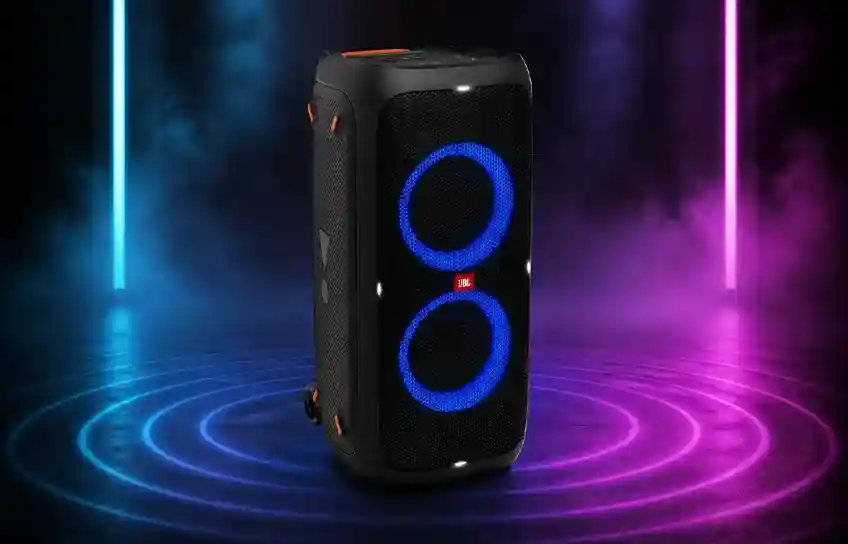
We are looking at the JBL PartyBox 310 review to give clear guidance on what this speaker is, who it is designed for, and where it fits. The PartyBox 310 is a battery powered portable party Bluetooth speaker built for loud, bass heavy events and casual live input use. It targets hosts who want a single box that can run outdoors, power a small karaoke mic setup, and add visual flair with an integrated light show. Strengths here are obvious: a claimed 240 watts of JBL Pro Sound, a long advertised battery life up to 18 hours under ideal conditions, mic and guitar inputs for live performance, and TWS linking for pairing multiple units.
Limitations are important to call out as well. The unit is heavy and bulky at about 17.4 kilograms, only splash resistant with an IPX4 rating, and not designed as a home theater or low latency gaming solution. In this review we unpack specifications, explain how key features affect real world use, describe setup and everyday performance for movies music and parties, highlight common problems and fixes, and offer a final verdict to help you decide whether the JBL PartyBox 310 is the right party speaker for your needs.
JBL PartyBox 310 Review: Quick Verdict
Best For
Hosts who want a single battery powered speaker with loud output, punchy bass and an onboard light show for outdoor parties and karaoke.
Not Ideal For
Buyers who need a lightweight grab and go speaker, a waterproof poolside unit, or a high fidelity home theater speaker.
Top Strengths
High party output with 240 watts, built in light show synced to music, long advertised battery life, mic and guitar inputs, TWS and daisy chain linking.
Biggest Weaknesses
Bulky and heavy to move, only splash resistant (IPX4), battery life and sound refinement drop with extreme volume and lights.
Bottom Line
The JBL PartyBox 310 review shows a powerful, party focused speaker that does exactly what it is designed for: loud, bass forward audio with lights and live input capability. If a single robust party speaker is needed it is worth considering. If portability, waterproofing or critical listening are priorities another option may be better.
Product Overview
The JBL PartyBox 310 sits in the portable party Bluetooth speaker category as a mid to large sized party speaker introduced in 2020 and kept current on the JBL product line. Its main highlights include an advertised 240 watts of output power, Bluetooth 5.1 connectivity, mic and guitar inputs for karaoke or live performance, a multi zone light show that syncs to music, and app control for effects and pairing. Market positioning is clear: this is a party centric, battery powered unit intended for outdoor gatherings, backyard events, and hosts who want an all in one system without separate lighting. The intended audience is people who put loudness and party features ahead of ultra light portability or audiophile refinement.
JBL PartyBox 310 Specifications
| Specification | Detail |
|---|---|
| Product | JBL PartyBox 310 |
| Output Power | 240 W |
| Channels | Stereo |
| Drivers | 2 × 6.5 in woofers and 2 × 2.5 in tweeters |
| Subwoofer | Integrated |
| Bluetooth | Bluetooth 5.1 (A2DP 1.3, AVRCP 1.6) |
| Auxiliary Input | 3.5 mm AUX |
| USB | USB-A playback |
| Mic/Guitar Inputs | 6.35 mm jacks |
| TWS / Daisy Chain | Supported |
| Battery Life | Up to 18 hours (advertised) |
| Splash Rating | IPX4 |
| Dimensions | 326 × 688 × 368 mm |
| Weight | 17.42 kg |
Why These Specifications Matter
When choosing a party speaker it helps to translate specs into real world benefits. The 240 watt rating tells how loud the PartyBox 310 is intended to be. For outdoor parties that means room filling output and strong bass presence. Bluetooth 5.1 gives stable wireless streaming and basic media controls, while AUX and USB provide reliable wired and direct playback options when Bluetooth is not ideal.
Mic and guitar inputs change the unit from a music speaker into a live performance hub for karaoke or small events. The IPX4 splash rating allows outdoor use around light rain or splashes but it is not a pool friendly waterproof device. Finally the weight and size mean planning for transport; the unit is portable in that it has a battery and wheels, but heavy enough that single person carry is not convenient.
Key Features Explained
The JBL PartyBox 310 review focuses on several core features that define the experience. First is the 240 watt JBL Pro Sound. What that does is deliver the loud output and bass needed for outdoor and large room parties. Why it matters is simple: volume and low end are the most important factors in a party environment. Who benefits are hosts and people running events who need impactful sound. The limitation is that this party tuning favors energy over subtlety, so critical listeners may find it less refined at extreme volumes.
Battery operation is another headline feature, with an advertised runtime of up to 18 hours. That matters because battery power frees events from AC outlets. Who benefits? Outdoor hosts and people who set up temporary events. The trade off is runtime depends heavily on how loud the speaker is played and whether the light show is active; at maximum volume and with lighting the real life battery will be considerably shorter.
The integrated light show is included and synced to music. It turns the speaker into a single device that provides both sound and lighting, which matters for casual parties that do not want separate lighting systems. Concert style or DJ users may still prefer dedicated lights, but for backyard gatherings this feature is a clear convenience. The limitation here is that heavier use of lights increases battery drain.
Mic and guitar inputs with onboard controls are built in to support live vocals and instruments. That is important for karaoke and impromptu performances. The benefit is being able to plug in a mic or guitar without extra mixers. Users should be cautious with mic gain and placement to avoid feedback.
TWS and daisy chain linking allow wirelessly pairing another PartyBox for stereo separation or adding more coverage. This matters for larger venues or to improve stereo imaging. It benefits event hosts that plan to scale sound coverage. The limitation is that this relies on pairing two of the same ecosystem speakers.
USB playback provides the convenience of playing files directly from a flash drive. For events where a USB stick is the simplest source, this is handy. It is not a headline feature but a useful backup.
Overall each of these features plays into the PartyBox 310’s role as a party first speaker: loud, visually engaging and capable of handling live inputs without a separate mixer.
Who Should Buy JBL PartyBox 310?
Ideal Buyers
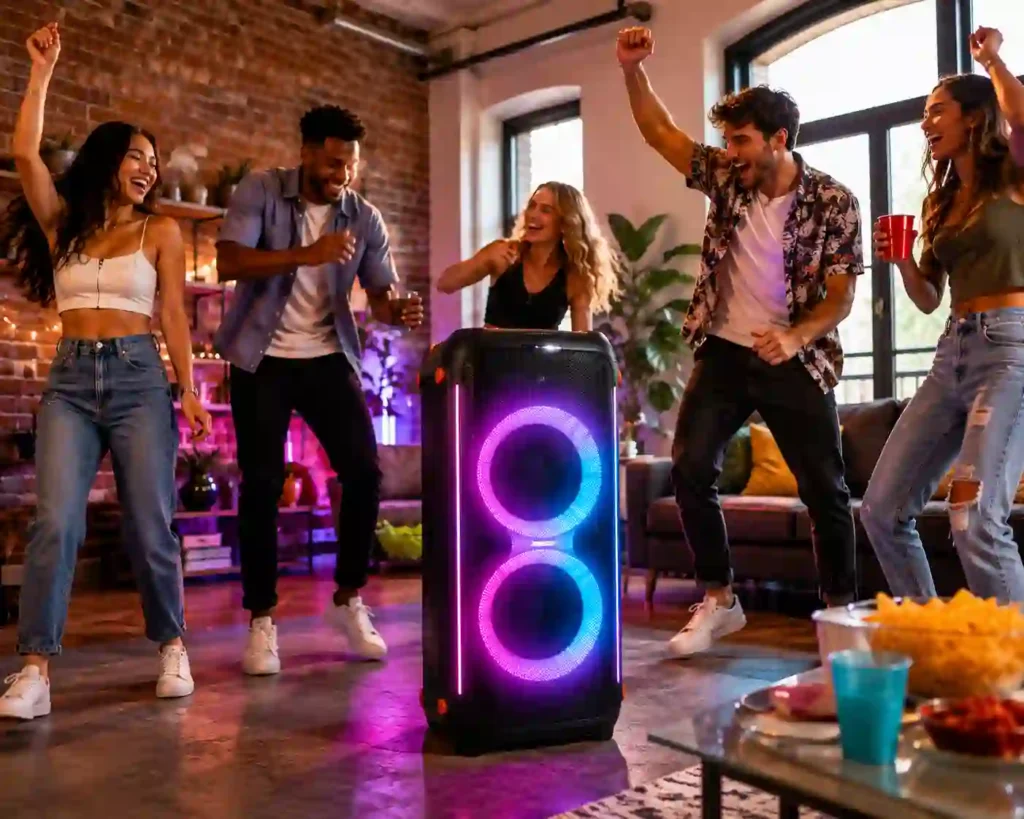
Buyers who want a battery powered single speaker that can run loud outdoors with strong bass, integrated lighting and karaoke capability. People who host frequent backyard parties, barbecues or small events and want an all in one unit that can be wheeled into place.
Who Should Avoid It
Those seeking a lightweight grab and go Bluetooth speaker, buyers who need a fully waterproof device for poolside immersion, and users looking for a dedicated home theater or low latency gaming audio solution.
Best Use Cases
Outdoor parties, backyard gatherings, karaoke nights, DJ practice or small event sound reinforcement where portability and lighting matter more than compact dimensions.
Less Suitable Use Cases
Small apartment critical listening, poolside submersion use, or single person frequent transport due to weight and footprint.
Design and Build Quality
The PartyBox 310 looks like a classic party speaker: a large black textured cabinet with an LED lit front grille and robust styling. Materials appear durable with a hard plastic cabinet and protective grille across the drivers, and fabric elements on the front. The unit is built with practical durability in mind, designed to handle party environments rather than delicate living rooms. Wheels and a retractable handle make moving the speaker easier, but it still weighs about 17.42 kilograms so moving it often is not trivial.
Durability for regular party use looks solid; the design favors a rugged feel and protection rather than lightweight convenience. Placement is best on the floor in open spaces for maximum bass and dispersion. The unit is not designed to be wall mounted and will take up a larger footprint in a room. The built in lights are integrated into the front grille and are a prominent design feature that adds visible impact at events. In short the build matches the PartyBox 310’s party first intentions: robust and practical rather than discreet and minimal.
Setup and Installation
Setup is straightforward. Charge the unit, power on, and pair via Bluetooth 5.1 with standard A2DP AVRCP profiles. For wired sources use the 3.5mm AUX input or USB-A playback. Mic and guitar inputs accept quarter inch jacks and have onboard controls for gain. The JBL PartyBox app can be used to control light patterns, sound effects, and TWS pairing when linking to another PartyBox.
Common issues during setup include Bluetooth pairing confusion if multiple PartyBox units or many Bluetooth devices are nearby, and occasional app connectivity problems. If pairing is problematic, power cycling the speaker and unpairing devices before attempting again typically resolves the majority of issues. For persistent issues, the Official JBL PartyBox 310 Manual includes a factory reset procedure.
Real World Performance
Movies and TV
For casual movie watching the PartyBox 310 delivers powerful effects and strong bass that make explosions and action scenes punchy. Dialogue clarity is acceptable for casual viewing at moderate volumes, but this speaker is not a dialogue centric soundbar replacement. In smaller rooms the emphasis on bass can become boomy at high volumes, so tone down the bass or volume for better clarity. The unit does not support Dolby Atmos or surround virtualization; TWS pairing can provide left right separation but will not recreate a discrete surround system.
Music Listening
The PartyBox 310 is tuned for party music. Vocals come through clearly enough for pop and dance tracks and the overall presentation focuses on energy and impact rather than fine detail. Instrument separation is adequate for party environments but not audiophile grade; the bass is punchy and strong which benefits EDM, hip hop and dance music. At maximum volume some users report bass becoming loose or compressed; for most party use the overall effect is enjoyable and engaging.
Gaming
Use for gaming is best in casual multiplayer or party gaming where loud impact is desired. Bluetooth introduces typical A2DP latency so wireless gaming may have lip sync issues for video heavy games. For lower latency the AUX input is recommended. On the positive side explosions and crowd noise gain a satisfying weight from the strong low end.
Voice Content and Podcasts
For spoken word content the PartyBox 310 performs acceptably at moderate volumes. Reducing bass and light effects improves clarity for podcasts and voice heavy material. For long listening sessions focused on voice, a smaller dedicated speaker may be more comfortable.
Indoor Use
In larger rooms the speaker fills space with ease. In small rooms care is required with volume and bass settings to avoid overwhelming the space. The light show can be distracting indoors during non party use and will drain battery faster.
Outdoor Use
This is where the PartyBox 310 shines. Battery operation, high output, and splash resistance allow outdoor gatherings at parks and backyards to be lively without constant AC power. For large outdoor events TWS pairing with a second unit spreads sound more evenly.
Summary of Strengths and Weaknesses in Real World
Strengths are loud output, impactful bass, useful lighting, and versatile live inputs. Weaknesses are bulk, less refined audio at maximum volume, and battery drain under heavy use with lights. For party hosts the strengths outweigh the drawbacks.
Best Settings
For music at parties enable the bass forward tuning and light show for maximum impact. For indoor or movie use reduce bass and dim or disable the lights to improve dialogue clarity and extend battery life. For gaming use wired AUX to cut Bluetooth latency and turn off lights to save battery. For karaoke lower mic gain to reduce feedback and place the mic away from the speaker.
Amazon Customer JBL PartyBox 310 Review Rating
| Stars (4.6/5) | Review (1,179 global ratings) |
| 5 Star | 78% |
| 4 Star | 15% |
| 3 Star | 3% |
| 2 Star | 1% |
| 1 Star | 3% |
Why Users Are Giving 4 & 5-Star Reviews
Most buyers are highly impressed with the JBL PartyBox 310 because it delivers the kind of powerful sound people expect from a premium party speaker. We found that users consistently praise the deep, punchy bass, crystal-clear vocals, and the ability to fill large rooms, gardens, and outdoor spaces with rich audio. Many say it performs like a compact DJ system, making it perfect for birthdays, family gatherings, and celebrations.
Another major reason for the high ratings is the premium build quality. We noticed that customers appreciate the sturdy design, integrated wheels, telescopic handle, and attractive LED light show, which make the speaker both durable and easy to move despite its size. Features like microphone support, Bluetooth connectivity, customizable EQ through the JBL Portable app, and long battery life also receive positive feedback. Overall, users believe the PartyBox 310 offers excellent value for those who want loud, immersive sound and reliable performance for parties.
Why Users Are Giving Below 3-Star Reviews
Although negative reviews are limited, they highlight a few recurring concerns that potential buyers should know about. We found that portability is one of the biggest drawbacks. While the built-in wheels and handle help, several users still feel the speaker is too large and heavy to transport frequently, especially for outdoor events or travel.
Battery performance is another common complaint. Some buyers report that the real-world battery life falls well short of JBL’s advertised figures, particularly when using higher volume levels or the LED lighting effects. Others mention that the JBL Portable app frequently requests firmware updates before use, which can become frustrating. A few customers also feel the premium price is difficult to justify unless they regularly host parties or need very high output. Overall, low ratings are mostly related to size, battery expectations, software inconveniences, and value rather than the actual sound quality, which remains widely appreciated.
Competitor Comparisons
JBL PartyBox 300
Choosing between the PartyBox 310 and the PartyBox 300 often comes down to incremental refinements and price. If the budget or availability makes the PartyBox 300 attractive, users preferring a similar PartyBox experience at potentially lower cost might pick the 300. Those who want the newest configuration with the PartyBox app and updated features should lean toward the PartyBox 310.
Sony SRS XP700
Sony’s large party speakers often compete on their own tuning and lighting approach. If a buyer prefers Sony’s sound signature or ecosystem, the Sony option may be preferable. If the priority is the specific PartyBox feature set including mic and guitar inputs, integrated karaoke capability and the JBL party focused tuning, then the PartyBox 310 is better.
JBL PartyBox 1000
The PartyBox 1000 targets much larger events with higher power and more pro level features. If professional level output for very large venues is required, the PartyBox 1000 may be the right selection. For most backyard parties and small events the PartyBox 310 offers a more practical balance of portability and power.
LG XBOOM Series
LG’s party speakers are an alternative for buyers wanting party features from a non JBL brand. Choice depends on which feature set, sound signature and price match the buyer’s needs. If the PartyBox ecosystem features are preferred, stick with the JBL PartyBox 310.
Pros and Cons
Pros
- 240 W output for room filling loudness and bass
- Bluetooth 5.1, AUX, USB playback and mic guitar inputs
- Integrated light show and PartyBox app control
- TWS and daisy chain linking for multi speaker setups
- IPX4 splash resistance and advertised up to 18 hour battery life
Cons
- Heavy and bulky at roughly 17.42 kilograms
- Only splash resistant not waterproof
- Battery life shortens significantly with lights on and max volume
- Not optimized for home theater or low latency gaming use
Value for Money
The value proposition of the PartyBox 310 centers on party features. If loudness, bass, integrated lighting and live input capability are primary requirements the PartyBox 310 delivers those elements and therefore presents strong value for event oriented users. For buyers prioritizing compact portability, waterproofing or critical listening nuance, the value is less compelling. The product’s mix of features justifies consideration for hosts who want a single speaker to handle sound, lights and karaoke.
Final Verdict
The JBL PartyBox 310 review shows a speaker designed with a single purpose: deliver loud, fun, party oriented audio with practical extras like lights and live inputs. Its biggest strengths are the 240 watt output, integrated light show, mic and guitar inputs and long advertised battery life. The biggest compromises are weight and bulk, splash only protection, and reduced sound refinement when pushed to extremes.
For backyard hosts, event organizers of small to medium gatherings, and people who want one box to supply both sound and lights, this is a compelling option. For those who need lightweight portability, pool proofing, or a precise home theater replacement, other devices are more appropriate. Overall the PartyBox 310 is recommended to buyers who prioritize party performance and features over absolute portability and audiophile detail.
How This Product Was Evaluated
This review examined the PartyBox 310 specifications, feature set and connectivity options, analyzed how those features translate into everyday use, and considered user feedback around battery life, portability and sound character. Performance for movies, music, gaming and live input was discussed based on the speaker’s tuning and real world user commentary. Competitor positioning within the PartyBox family and other large party speakers informed the buying guidance.
Does the JBL PartyBox 310 come with a microphone?
Official materials do not list a microphone as a standard included accessory. Mic inputs are provided for external microphones.
How long does the JBL PartyBox 310 battery last?
JBL advertises up to 18 hours of playback under ideal conditions. Real world runtime depends heavily on volume, light usage and live inputs.
Is the PartyBox 310 waterproof?
No it is not waterproof. It has an IPX4 splash resistance rating.
Can two PartyBox 310 speakers be paired?
Yes. TWS and daisy chain linking are supported to pair multiple PartyBox units for stereo or wider coverage.
Does the PartyBox 310 support Dolby Atmos or DTS?
No Dolby Atmos or DTS processing is listed in the specifications.
What are common JBL Partybox 310 problems?
Common issues reported include Bluetooth pairing confusion in busy environments, battery life reduction under heavy use with lights on and mic feedback when gain is too high. Power cycling, unpairing and re pairing, using wired AUX, lowering mic gain and turning off lights are typical solutions.
Is it worth buying JBL PartyBox 310?
For buyers seeking a powerful, feature rich party speaker with lights and live inputs the JBL PartyBox 310 is worth buying. If lightweight portability, waterproofing or home theater fidelity are primary needs, it is less suitable.
Best Sound Setting For JBL PartyBox 310?
For parties enable bass forward settings and lights. For indoor movies or voice reduce bass and dim or disable lights. For gaming use wired AUX to reduce latency.