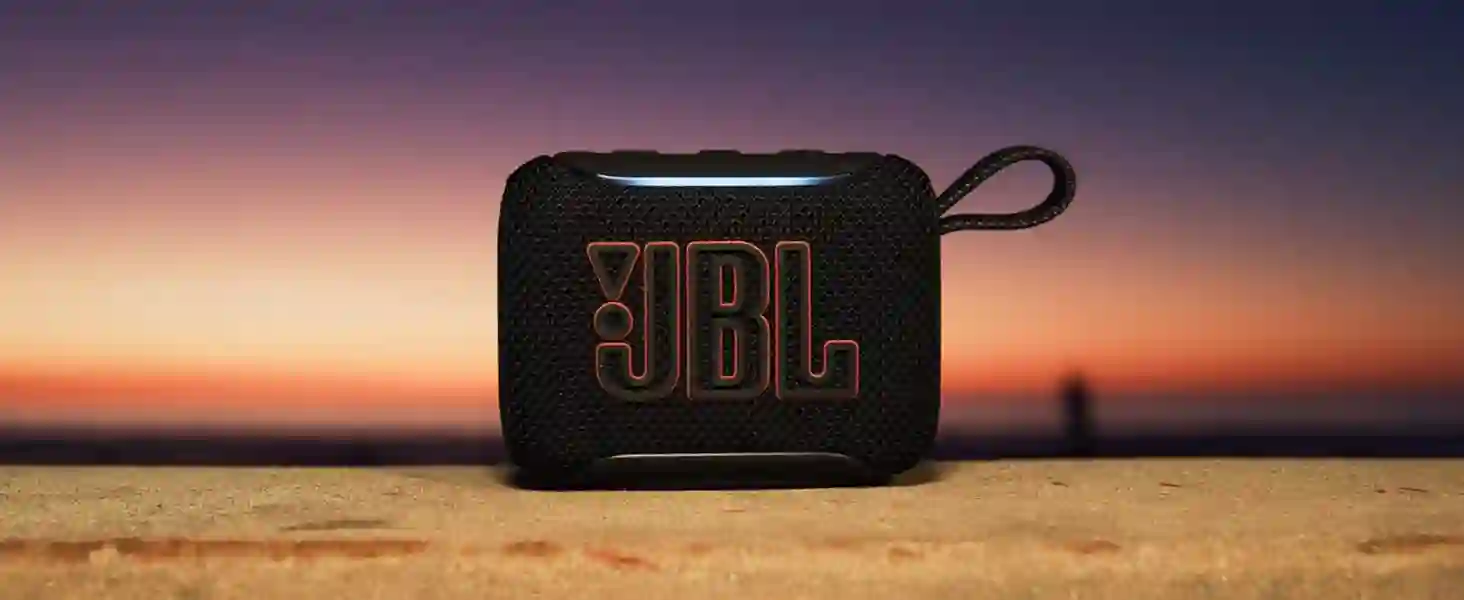
The JBL Go 5 is designed for people who want a compact Bluetooth speaker that can easily fit into a bag or travel with them outdoors. But does its small size come at the expense of sound quality, battery life and everyday usability?
In this JBL Go 5 review, we examine its sound performance, Bluetooth 6.0 connectivity, USB-C audio playback, IP68 protection and battery features. We also look at how it compares with the JBL Go 4 and competing portable speakers to understand whether the latest model offers enough improvements to justify its purchase.
If you are looking for a pocket-sized speaker for travel, casual music listening or outdoor use, this review will help you understand its strengths, limitations and whether it is the right choice.
JBL Go 5 Review: Quick Verdict
Best For
People wanting a very small rugged speaker for travel and outdoor casual listening.
Not Ideal For
Those who need deep bass, long battery life at loud levels, speakerphone functions, or wired 3.5 mm AUX.
Top Strengths
- Compact and lightweight IP68-rated design
- Bluetooth 6.0 with SBC, AAC and LC3 codec support
- USB-C charging and lossless wired audio playback
- JBL Portable app with 7-band EQ and lighting controls
- AirTouch stereo pairing with another JBL Go 5
Biggest Weaknesses
- Limited deep-bass performance due to its compact size
- Up to 8 hours of advertised standard battery life
- No documented 3.5 mm AUX input
- USB-C charging cable is not included in the box
- No documented built-in speakerphone functionality
Bottom Line
This JBL Go 5 review finds the Go 5 a well rounded ultra portable speaker that improves on its predecessor in connectivity and usability while remaining limited by physics and size. It is an attractive purchase for anyone who wants a rugged pocket speaker with modern codecs and app EQ.
JBL Go 5 Review Specifications
| Specification | Details |
|---|---|
| Channels | Mono |
| Total Output Power | 4.8 W RMS |
| Driver | 1 × 45 mm full range transducer |
| Frequency Response | 87 Hz – 20 kHz (−6 dB) |
| Bluetooth | Version 6.0 |
| Supported Codecs | SBC, AAC, LC3 |
| Profiles | A2DP v1.4, AVRCP v1.6 |
| Connectivity | Bluetooth, USB C charging and wired audio |
| Battery | Li ion 3.85 Wh (≈1000 mAh) |
| Playtime | Up to 8 hours; up to 10 hours with PlayTime Boost |
| Charge Time | Approximately 3 hours at 5 V 1 A |
| Water Dust Rating | IP68 |
| Dimensions | 101 × 77.4 × 43 mm |
| Weight | 231 g |
| Package Contents | Speaker, Quick Start Guide, Warranty Card, Safety Sheet |
Key Features Explained
In JBL Go 5 review, we make it clear what the main features do and why they matter. Bluetooth 6.0 with LC3 offers a modern wireless link that can be more stable and efficient on compatible devices. For a portable speaker that will travel through pockets and backpacks, that improved pairing and reduced dropout risk matters.
USB-C is used for both charging and lossless wired audio playback. This gives users an alternative to Bluetooth when connecting a compatible USB audio source. The source device and audio content must support the required USB audio connection, and users should follow JBL’s instructions for activating wired playback. The JBL Portable app also provides a 7-band EQ, allowing users to adjust the sound according to their listening preferences.
The IP68 rating makes the JBL Go 5 suitable for use in dusty environments and provides protection against water under specified conditions. JBL’s global manual specifies water protection at a depth of 1.5 metres for up to 30 minutes. Before exposing the speaker to water, disconnect all cables. After exposure, follow JBL’s cleaning instructions and ensure the speaker is completely clean and dry before charging. PlayTime Boost extends the advertised playback time, but JBL’s documentation does not quantify a specific reduction in bass or sound output when this mode is enabled.
Each of these features benefits certain users. Travelers and outdoor fans will value IP68 and compactness. Tech conscious listeners will like LC3 and USB C. People who want the best possible single unit sound will be limited by the physical driver and enclosure.
Design and Build Quality
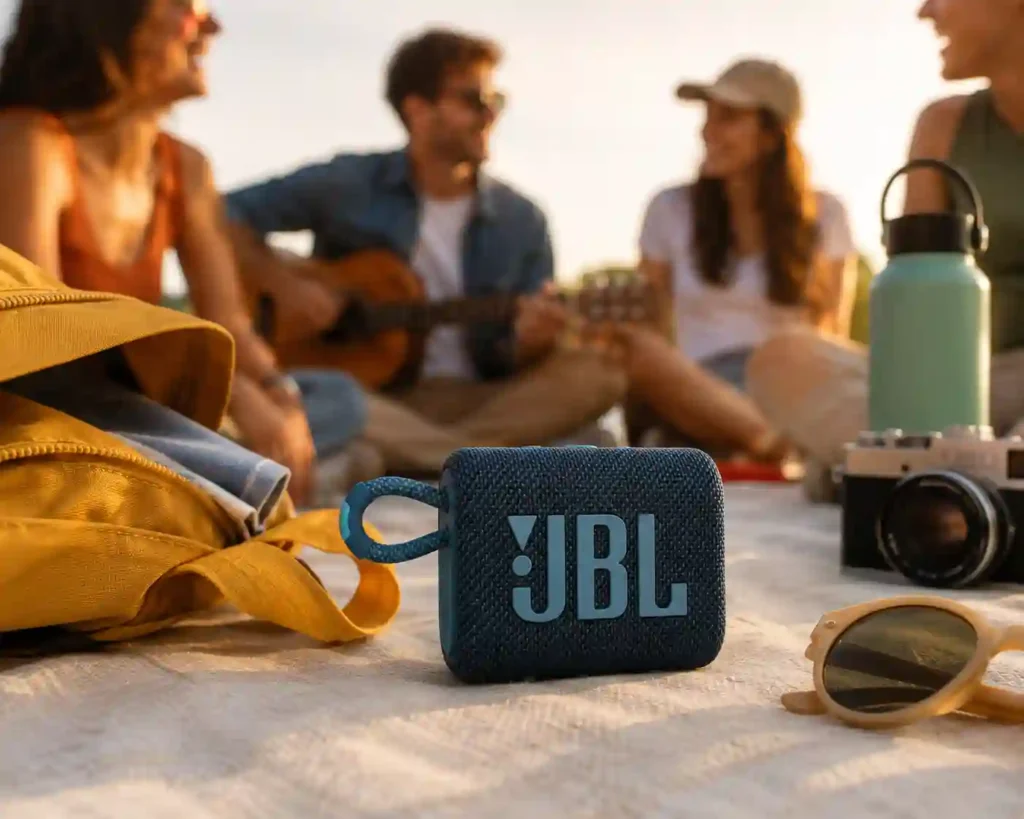
This JBL Go 5 review finds the design straightforward and intentionally compact. The speaker is palm sized, lightweight, and covered with tactile materials. The grille and rubberized housing deliver a rugged feel that aligns with the IP68 rating. Multiple color finishes are available, giving options for personal taste.
The small form factor makes placement simple. It sits well on tables, counters, and backpacks. Because the grille must remain unobstructed for the best sound, keeping the speaker upright on a flat surface works best. The standard package does not include wall-mount hardware. JBL’s reviewed specifications and user manual do not document built-in microphone or speakerphone functionality, so the Go 5 should not be treated as a hands-free calling speaker.
Durability is a strong point. The IP68 rating provides confidence near water and in dusty outdoor conditions. Reviews describe it as solid and suitable for outdoor rough use. The trade off is obvious. A tiny enclosure and single driver keep weight and size down but limit bass and overall loudness compared with larger portable speakers.
Setup and Installation
Setting up the JBL Go 5 is straightforward. If the speaker needs charging, connect it to a suitable USB power source using a compatible USB-C cable, which must be purchased separately because JBL does not include one in the standard package.
Switch on the speaker and enable Bluetooth on your phone, tablet or other source device. Select the JBL Go 5 from the available Bluetooth devices to complete wireless pairing.
For additional controls, install the JBL Portable app. It provides access to the 7-band EQ, lighting themes, firmware updates and speaker-pairing features.
The USB-C port also supports lossless wired audio playback with compatible source devices. Follow the instructions in JBL’s Quick Start Guide to activate and use this feature.
Sound Performance
Movies and TV
In this JBL Go 5 review, near field dialogue clarity is a strength. The mids are clear and vocal centric material comes through well for casual TV viewing or laptop video. The single 45 mm transducer and compact enclosure limit the speaker’s ability to reproduce deep bass effects. JBL lists a frequency response of 87 Hz–20 kHz (−6 dB), but this specification alone does not establish the exact bass performance of the speaker in a room. Stereo imaging is not available from one unit but pairing two Go 5 speakers improves left right separation.The bass is improved compared with the previous generation
Music Listening
Music sounds surprisingly punchy given the size. Vocals are expressive and mids are clear. JBL claims that the Go 5 delivers louder sound and deeper bass than its predecessor. However, the published specification sheet does not provide comparative measurements to quantify this improvement. For pop, acoustic, and vocal centric tracks the Go 5 performs well as a portable companion. Using the app based 7 band EQ makes the biggest perceived difference for music. A mild boost in the lower mids and careful treble control will produce fuller perceived bass and a clearer top end.
Gaming
This JBL Go 5 review notes that the mono design and unknown real world latency make the speaker a poor choice as the main gaming audio device.The JBL Go 5 supports Bluetooth 6.0 and LC3, but JBL does not publish a measured end-to-end latency figure or a gaming-latency guarantee for this speaker. Therefore, its suitability for competitive gaming cannot be established from the Bluetooth version or codec support alone. For casual mobile gaming in a near field scenario it is acceptable, but competitive gaming benefits from headphones or larger stereo setups.
Voice Content and Podcasts
Podcast and spoken word benefit from the Go 5’s clear mids. For near field listening the speaker reproduces voices with intelligibility. For group listening in a larger room spoken content will lack the presence required to fill space convincingly.
Indoor Use
Indoors this speaker works best as a personal or near field device. It is excellent on a desk, kitchen counter or bedside table. It does not replace a larger Bluetooth speaker for parties or big living room playback. Stereo pairing two units helps expand the soundstage for small gatherings.
Outdoor Use
Outdoor is where the Go 5 shines as described in this JBL Go 5 REVIEW. The IP68 rating, compact size and weight make it an easy grab and go speaker for picnics, beaches and poolside. The rugged build reduces worry about dust and splashes. Loudness is adequate for small groups in close range but for open spaces or noisy environments the limited low end and maximum volume become apparent.
Overall Sound Character
Across these scenarios the speaker favors clear mids and treble with a tighter, controlled low end rather than deep sub bass. Users who accept the physical limits can get a lot from the Go 5 by using the app EQ and situational tweaks like stereo pairing. USB-C wired playback provides an alternative to Bluetooth when using a compatible source device. Whether it produces an audible improvement depends on the source, content and playback conditions.
Best Settings
The JBL Portable app includes a 7-band EQ that allows users to adjust the sound according to their preferences. There is no single best EQ setting for every listener or music genre, but the following adjustments can be used as starting points:
- Music: Experiment with a modest lower-mid adjustment if you prefer a fuller sound. Adjust the treble according to your listening preference.
- Movies and TV: Try a more balanced or vocal-focused EQ to suit dialogue-heavy content.
- Battery life: Use PlayTime Boost when longer playback is more important than standard playback time.
- Stereo listening: Pair two JBL Go 5 speakers using AirTouch when you want separate left and right audio channels.
These are suggested starting points rather than manufacturer-recommended or independently verified optimal settings. Adjust the EQ based on your own listening preferences.
Amazon Customer JBL Go 5 Review Rating
| Stars (4.6/5) | Review (183 global ratings) |
| 5 Star | 83% |
| 4 Star | 9% |
| 3 Star | 3% |
| 2 Star | 1% |
| 1 Star | 4% |
Why Users Are Giving 4 & 5-Star Reviews
Most buyers are delighted with the JBL Go 5 because it delivers surprisingly powerful sound from such a compact speaker. We found that users consistently praise its clear vocals, punchy bass, and impressive volume, making it ideal for personal listening, travel, hiking, and small outdoor gatherings. Many reviewers also mention that the audio quality is noticeably better than previous Go models, especially when using the JBL Portable app to fine-tune the EQ.
Another reason for the high ratings is the speaker’s premium build quality and portability. We noticed that customers appreciate its rugged design, lightweight body, and durability for everyday use in different weather conditions. Bluetooth pairing is described as quick and reliable, while Auracast speaker pairing, customizable LED lighting, and long battery life add extra value. Overall, users believe the JBL Go 5 offers excellent performance for its size and price, making it one of the best ultra-portable Bluetooth speakers currently available.
Why Users Are Giving Below 3-Star Reviews
Although negative reviews are relatively uncommon, we identified several recurring complaints among less satisfied buyers. The most common issue is that the improvements over the JBL Go 4 feel minor. Some users expected a much bigger upgrade in sound quality and bass but felt the differences were too small to justify purchasing the newer model.
Another concern is the missing charging cable, which disappointed several buyers who expected one to be included in the box at this price. A few reviewers also describe the LED lighting as more of a novelty than a useful feature, saying it adds little to the overall experience. Others note that enabling Battery Saver mode noticeably reduces bass and overall sound quality. There are also isolated complaints about receiving the wrong color instead of the one ordered. Overall, lower ratings are mainly driven by unmet expectations, missing accessories, and limited improvements rather than poor audio performance or build quality.
JBL Go 5 vs Competitors: Which Speaker Should You Buy?
The JBL Go 5 offers USB-C audio playback, a 7-band EQ, AirTouch stereo pairing and IP68 protection. However, competitors have their own advantages. The JBL Go 4 is lighter, the Sony SRS-XB100 offers longer battery life, and the Anker Soundcore 2 prioritizes extended playback and AUX connectivity.
JBL Go 5 Comparison Table
| Specification | JBL Go 5 | JBL Go 4 | Sony SRS-XB100 | Soundcore 2 | Bose SoundLink Micro |
|---|---|---|---|---|---|
| Driver | 45 mm | 45 mm | 46 mm | Dual 1.5-inch | Not specified |
| Output Power | 4.8 W RMS | 4.2 W RMS | Not specified | 12 W advertised | Not specified |
| Bluetooth | 6.0 | 5.3 | 5.3 | 6.0* | 4.2 |
| Codecs | SBC, AAC, LC3 | Not specified | SBC, AAC | Not specified | Not specified |
| Audio Input | USB-C, Bluetooth | Bluetooth | Bluetooth | AUX, Bluetooth | Bluetooth |
| Battery Life | 8 hours (10 with Boost) | 7 hours (9 with Boost) | 16 hours | 24 hours | 6 hours |
| Charging Port | USB-C | USB-C | USB-C | Micro-USB* | Micro-USB |
| Water Resistance | IP68 | IP67 | IP67 | IPX7 | IP67 |
| Weight | 230 g | 190 g | 274 g | 414 g | 308 g |
| Microphone | Not documented | Not documented | Yes | Yes | Yes |
| Stereo Pairing | Yes | Yes | Yes | Yes* | Yes, compatible Bose models |
| App EQ | 7-band EQ | Yes | No EQ | Not specified | No EQ |
Soundcore 2 specifications vary by hardware revision. Confirm the version before purchasing. Bose specifications refer to the original SoundLink Micro, not the 2nd Gen. Battery figures are manufacturer ratings and are not directly comparable test results.
JBL Go 5 vs JBL Go 4
The Go 5 improves on the Go 4 with Bluetooth 6.0, USB-C audio playback, AirTouch pairing and IP68 protection. Output increases from 4.2 W to 4.8 W RMS, while advertised battery life improves from seven to eight hours.
However, the Go 4 is lighter at 190 g compared with approximately 230 g for the Go 5.
Buying advice: Choose the Go 4 if portability and lower pricing matter most. Choose the Go 5 if you want USB-C audio, newer connectivity and additional features.
JBL Go 5 vs Sony SRS-XB100
The Sony SRS-XB100 offers up to 16 hours of advertised battery life, compared with eight hours for the Go 5. It also includes a built-in microphone for hands-free calls and a 360-degree sound design.
The Go 5 offers more customization through its 7-band EQ, USB-C wired audio and Auracast connectivity.
Buying advice: Choose Sony for longer battery life and hands-free calls. Choose JBL for connectivity, sound customization and additional features.
JBL Go 5 vs Anker Soundcore 2
The Soundcore 2 prioritizes battery life, offering up to 24 hours of advertised playback. It also includes dual drivers and a 3.5 mm AUX input.
However, at 414 g, it is considerably heavier than the 230 g JBL Go 5. The Go 5 is more suitable for travel, while the Soundcore 2 is better suited to users who prioritize longer playback and wired connectivity.
Buying advice: Choose Soundcore 2 for battery life and AUX connectivity. Choose Go 5 for portability, IP68 protection and USB-C audio.
JBL Go 5 vs Bose SoundLink Micro
The original Bose SoundLink Micro offers a built-in microphone, speakerphone functionality and a tear-resistant strap for attaching it to bags.
However, its Bluetooth 4.2 connection, Micro-USB charging and six-hour advertised battery life make it less versatile than the Go 5 in terms of modern connectivity.
Buying advice: Choose Bose if you need its attachment strap or speakerphone. Otherwise, the Go 5 offers a more modern feature set.
Which Speaker Should You Buy?
| Your Priority | Recommended Speaker |
|---|---|
| Lightweight portability | JBL Go 4 |
| Longer battery life | Anker Soundcore 2 |
| Bass-focused casual listening | Sony SRS-XB100 |
| Modern connectivity and outdoor use | JBL Go 5 |
| Attaching to bags | Bose SoundLink Micro |
| USB-C wired audio | JBL Go 5 |
| AUX connectivity | Anker Soundcore 2 |
Final Buying Recommendation
The JBL Go 5 is a strong choice for buyers who want a compact speaker with modern connectivity, USB-C audio, app-based EQ and IP68 protection.
However, it isn’t automatically the best option for everyone. The Sony SRS-XB100 is more suitable for longer playback, the Soundcore 2 offers better advertised battery life, and the Go 4 is lighter and may offer better value at a lower price.
Ultimately, choose the Go 5 if its additional features justify the price difference for your intended use.
How This Product Was Evaluated
Our evaluation of the JBL Go 5 is based on official specifications, manufacturer documentation, customer feedback and comparisons with competing Bluetooth speakers. We examined its sound capabilities, battery life, connectivity, durability and practical features to understand its strengths and limitations. Customer reviews were analysed to identify common user experiences and concerns. Our conclusions distinguish verified specifications from customer opinions and editorial assessments rather than claiming unverified hands-on testing.
Is the JBL Go 5 waterproof?
Yes the speaker has an IP68 rating for water and dust resistance making it suitable for poolside or beach use.
How long does the JBL Go 5 battery last?
Official playtime is up to eight hours with light effects off. PlayTime Boost can extend runtime in exchange for reduced sound fullness. Real world runtime at moderate to loud volumes is often lower.
Does the JBL Go 5 support wired audio?
Yes the speaker supports USB C wired audio in addition to charging.
Can two JBL Go 5 units be paired for stereo?
Yes two units can be stereo paired using the JBL Portable app for left right separation.
Does the JBL Go 5 have a microphone for calls?
No the Go 5 does not include a built in microphone so it cannot be used as a speakerphone.
What Bluetooth codecs and version are supported by JBL Go 5?
Bluetooth 6.0 is supported along with SBC AAC and LC3 codecs.
Is it worth buying JBL Go 5?
For people who need a very compact rugged speaker with modern connectivity app EQ and optional wired USB C audio the Go 5 offers strong value. Buyers who need deep bass very high volume or built in call handling should consider other models.
What are the best sound setting for JBL Go 5?
Use the JBL Portable app 7 band EQ to boost lower mids modestly and adjust treble to taste. Disable PlayTime Boost for the fullest sound and enable it only when battery life is the priority. Pair two units for better stereo spread in larger listening scenarios.