
The Sennheiser AMBEO Soundbar Max promises something few soundbars can deliver: an expansive Dolby Atmos home theater experience from a single unit, without separate rear speakers or a dedicated subwoofer. With 13 drivers, AMBEO 3D virtualization, and automatic room calibration, it aims to create immersive surround sound while keeping your home entertainment setup relatively simple.
But the AMBEO Max is not for everyone. Its large, heavy design demands considerable space, and its premium price puts it in competition with newer soundbars that offer dedicated subwoofers and rear speakers. Although its advanced audio processing and built-in bass capabilities are impressive on paper, the listening experience depends heavily on room acoustics, placement, and personal expectations.
In this Sennheiser AMBEO Max review, we’ll examine its sound quality, Dolby Atmos performance, bass capabilities, connectivity, room calibration, and practical limitations using official specifications and published independent reviews. We’ll also compare it with alternatives from Sonos, Bose, and Samsung to help you decide whether this flagship soundbar is still worth buying in 2026. For full specs, see Sennheiser’s official product page.
Quick Verdict
The Sennheiser AMBEO Soundbar Max remains a powerful single-bar home theater option in 2026, delivering immersive 5.1.4 virtual surround sound, Dolby Atmos and DTS support, and bass extension rated down to 30Hz without requiring a separate subwoofer. Its biggest strengths are its expansive soundstage, clear dialogue, room calibration, and versatile connectivity.
However, its bulky design, premium price, and less forceful bass compared to systems with dedicated subwoofers make it a better choice for certain buyers than others.
Best For
- Home theater enthusiasts who want immersive Dolby Atmos and convincing virtual surround effects without installing multiple speakers.
- Medium-to-large room owners who prioritize powerful sound, dialogue clarity, and room calibration.
- Streaming-focused users who need AirPlay 2, Chromecast, Spotify Connect, Tidal Connect, Bluetooth, and multiple HDMI inputs.
Not Ideal For
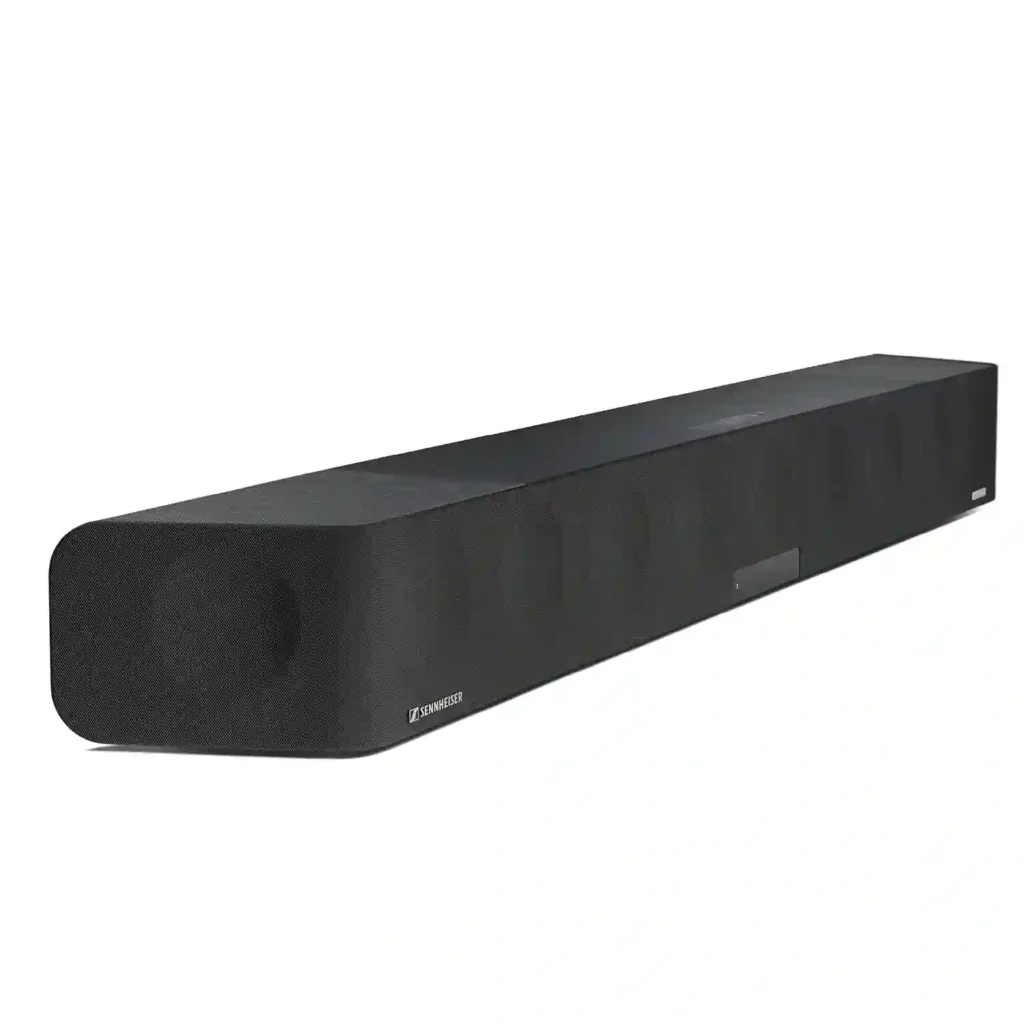
- Small-room setups with limited TV stand space, as the soundbar is nearly 50 inches wide and weighs approximately 18.5 kg.
- Bass-focused listeners who prefer the physical impact of a dedicated subwoofer.
- Budget-conscious buyers who can get sufficient performance from more affordable Dolby Atmos soundbars.
Bottom Line
The Sennheiser AMBEO Max is worth considering in 2026 if you want premium cinematic sound from a single unit and have the space and budget for it. However, buyers seeking stronger subwoofer impact, genuine rear surround speakers, or better value should compare it with newer premium alternatives before purchasing.
How We Reviewed: This Sennheiser AMBEO Max review is based on official product specifications, independent audio measurements, expert reviews, and reported user experiences. We evaluated sound quality, Dolby Atmos performance, connectivity, usability, and overall value to help you make an informed buying decision.
Sennheiser AMBEO Max Review: Sound Performance & Sound Quality
The Sennheiser AMBEO Max features 13 drivers, including six woofers, five tweeters, and two upward-firing drivers. Its AMBEO 3D processing creates a virtual 5.1.4-channel sound experience, while automatic room calibration adjusts the audio to your room’s acoustics.
Movies & TV
The AMBEO Max excels at movies and TV, delivering clear dialogue, powerful dynamics, and an expansive soundstage. Voices remain intelligible during action-heavy scenes, while Dialogue Normaliser and Night Mode help improve everyday viewing.
Its ability to reproduce subtle background details alongside explosive effects makes it particularly suitable for cinematic content. However, surround immersion depends on room layout and proper calibration.
Dolby Atmos & Surround Sound
Dolby Atmos and DTS:X are among the AMBEO Max’s biggest strengths. Its upward-firing drivers and virtual surround processing create convincing height effects, making sounds appear to move above and around the listener.
However, virtual surround cannot fully replace physical rear and ceiling speakers. While the experience is immersive, precise rear-channel separation is less convincing than a dedicated 5.1.4 system.
Music Performance
For music, the AMBEO Max delivers detailed vocals, a wide soundstage, and controlled bass. Its larger drivers produce a fuller presentation than many compact soundbars.
However, bass-heavy tracks may lack the deepest low-frequency impact. AMBEO processing can increase spaciousness but may introduce excessive reverberation at higher settings.
Recommended starting point: Use the Music or Neutral preset with AMBEO processing at a moderate level, adjusting the EQ according to preference.
Gaming Performance
The AMBEO Max provides immersive gaming audio, with a wide soundstage that enhances environmental effects, explosions, and directional cues.
Its main limitation is HDMI connectivity. Although it supports 4K HDR and Dolby Vision passthrough, it lacks modern gaming features such as 4K/120 Hz passthrough, VRR, and ALLM.
Best setup: Connect your PS5 or Xbox Series X directly to your TV and use HDMI eARC to send audio to the soundbar.
Room Acoustics & Placement
The AMBEO Max relies on sound reflections from walls and ceilings to create its virtual surround experience. Room calibration improves performance, but placement remains important.
- Small rooms: Powerful sound, but its large size and output may be excessive.
- Medium-to-large rooms: Best suited for its expansive soundstage and strong dynamics.
- Open-plan rooms: Uneven reflections may reduce surround precision and height effects.
Positioning the soundbar centrally, with unobstructed upward-firing drivers, helps maximize immersion.
Low-Volume Listening
The AMBEO Max maintains good dialogue clarity at lower volumes, making it suitable for TV shows, podcasts, and late-night viewing.
Night Mode helps control loud effects, while dialogue enhancement improves speech intelligibility. However, bass impact may become less noticeable at quieter listening levels.
Can the Sennheiser AMBEO Max Replace a 5.1.4 Home Theater?
Yes, to an extent. The AMBEO Max offers an impressive single-soundbar alternative to a traditional surround system, combining immersive Dolby Atmos, powerful output, and room calibration without requiring separate rear speakers.
However, it cannot fully reproduce the precise rear effects, overhead localization, or deep bass impact of a dedicated 5.1.4 speaker system with a subwoofer.
Final recommendation: Choose the AMBEO Max if you want cinematic sound with minimal speaker clutter, particularly in a medium-to-large room. If accurate rear-channel effects, powerful sub-bass, and future expandability are priorities, a traditional surround system remains the better choice.
Design & Build Quality
The Sennheiser Ambeo Max immediately sets itself apart with a premium build that feels solid and well-engineered. Wrapped in a combination of brushed aluminum and acoustic fabric, the soundbar delivers a sleek yet professional look that complements modern entertainment setups. Its design strikes the right balance between elegance and durability, giving it a true flagship presence.

In terms of dimensions and weight, the Ambeo Max is significantly larger and heavier than most competing soundbars. Measuring over a meter in length and weighing close to 18 kilograms, it demands both space and a sturdy TV cabinet or stand to accommodate it. This bulk is partly due to the number of drivers packed inside to deliver its expansive 5.1.4 channel virtual surround experience, but it does make placement a challenge in smaller living rooms. By contrast, slimmer competitors like the Sonos Arc (weighing just 6.25 kg) are designed for subtle integration, highlighting how the Ambeo prioritizes power over minimalism.
On the usability front, the soundbar integrates an OLED display that provides clear feedback on source selection, volume, and settings, paired with responsive touch-sensitive controls on the top panel. Sennheiser also includes a well-designed remote control, giving users easy access to key functions without needing to rely solely on the companion app.
While the robust build quality is impressive, the sheer bulkiness of the Ambeo Max remains one of its notable drawbacks. Unlike slimmer soundbars from Bose or Sonos, this model is not designed to blend subtly into the background, it dominates your setup both visually and physically. That said, Sennheiser backs its build with a two-year international warranty, and the official manual emphasizes its long-term durability, ensuring peace of mind for buyers investing in this flagship model.
Connectivity & Smart Features
The Sennheiser AMBEO Soundbar Max offers excellent connectivity for a premium soundbar, with three HDMI inputs, HDMI eARC, Wi-Fi, Bluetooth, and multiple streaming options. However, its 4K/60Hz passthrough limitation makes it less suitable for direct connections to modern gaming consoles.
| Feature | Specification |
|---|---|
| HDMI Inputs | 3 HDMI inputs |
| HDMI Output | 1 HDMI eARC output |
| Video Passthrough | Up to 4K/60Hz, Dolby Vision |
| Optical Input | 1 optical audio input |
| Analog Input | Stereo RCA AUX |
| Subwoofer Output | 1 RCA subwoofer pre-out |
| Bluetooth | 4.2 with AAC, SBC and NFC pairing |
| Wi-Fi | Dual-band Wi-Fi |
| Ethernet | 1 RJ-45 port |
| Music Streaming | AirPlay 2, Chromecast, Spotify Connect, TIDAL Connect, UPnP |
| Audio Formats | Dolby Atmos, DTS, MPEG-H and other supported formats |
Smart Features and Voice Assistants
The AMBEO Max uses AMBEO OS and the Sennheiser Smart Control app for room calibration, EQ adjustments, AMBEO 3D settings, firmware updates, and source selection.
Wireless streaming through AirPlay 2, Chromecast, Spotify Connect, and TIDAL Connect makes it convenient for both Android and Apple users.
Google Assistant and Alexa compatibility may vary by region and connected devices. Unlike soundbars with built-in voice assistants, the AMBEO Max is primarily designed for premium audio performance rather than hands-free smart-home control.
Is the Sennheiser AMBEO Max Good for PS5 and Xbox Series X?
Yes for immersive gaming audio, but not for direct 4K/120Hz passthrough.
The AMBEO Max supports Dolby Atmos and DTS, making it capable of delivering immersive gaming sound when the source and connection are compatible. However, its HDMI inputs are limited to 4K/60Hz and do not pass through 4K/120Hz, VRR, or ALLM.
Recommended Connection:
PS5 / Xbox Series X → TV HDMI 2.1 → TV HDMI eARC → AMBEO Max
This setup allows a compatible TV to handle 4K/120Hz, VRR, and ALLM while sending supported audio formats to the soundbar through eARC. Audio-format availability depends on the console, game, and TV settings.
Best Sennheiser AMBEO Max Settings and Placement Guide
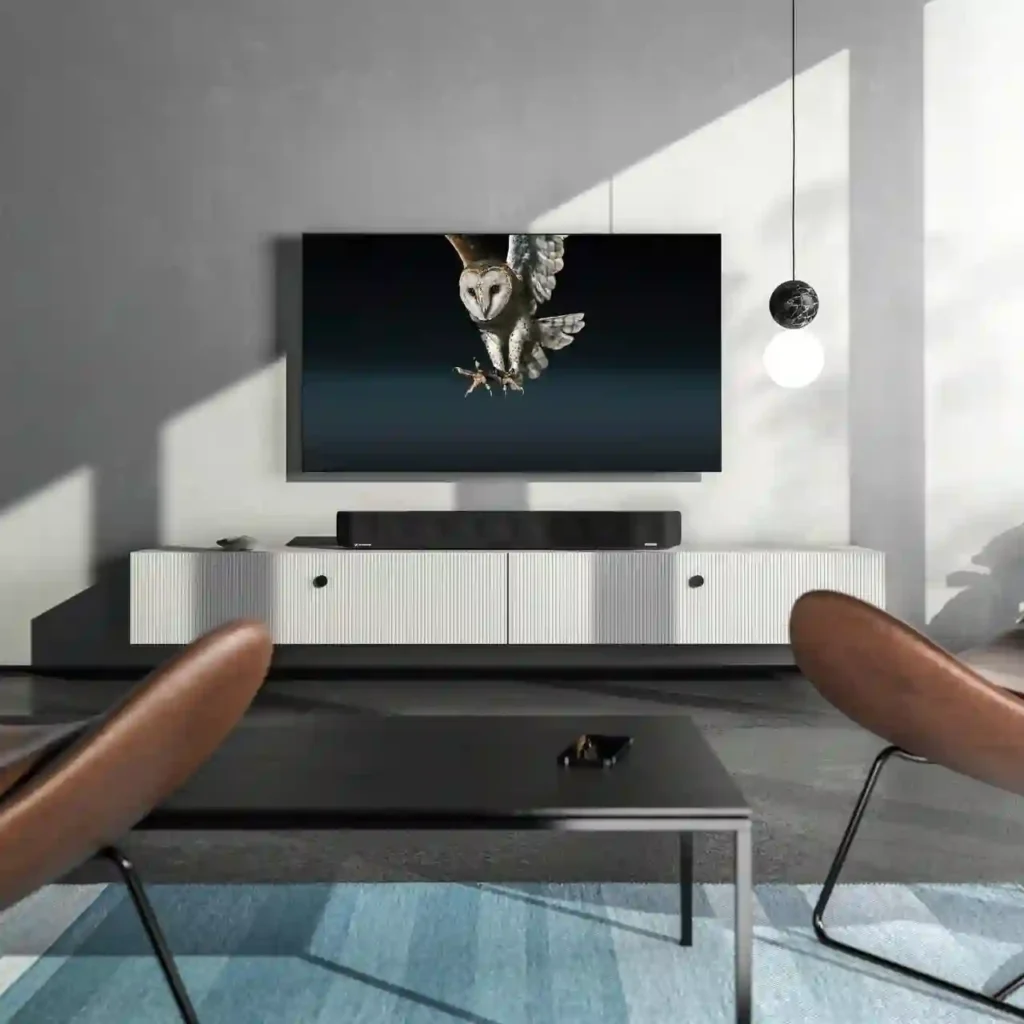
The Sennheiser AMBEO Max delivers its best performance when properly calibrated, correctly positioned, and adjusted for different content. Its AMBEO 3D processing, equalizer, and room calibration allow you to customize the sound for movies, music, gaming, and everyday TV viewing.
Recommended Settings for Different Content
| Content Type | Recommended Settings | Why It Helps |
|---|---|---|
| Dolby Atmos Movies | Use HDMI eARC, a Dolby Atmos source, and start with Standard AMBEO 3D processing. | Creates immersive surround and height effects. |
| Music | Use Neutral EQ and low AMBEO 3D processing. | Maintains natural vocals and instrument separation. |
| Dialogue & TV | Enable Dialogue Enhancement and reduce AMBEO intensity if needed. | Improves speech clarity during news, dramas, and documentaries. |
| Gaming | Connect console to TV, then TV eARC to soundbar. Start with Standard AMBEO 3D. | Preserves compatible TV gaming features while delivering immersive audio. |
| Bass-Heavy Content | Increase bass slightly using the EQ. | Adds impact without overwhelming other frequencies. |
| Night Listening | Enable Night Mode and Dialogue Enhancement if needed. | Reduces loud volume peaks while keeping speech understandable. |
Tip: Avoid using maximum AMBEO 3D processing for every source. Higher settings may increase spaciousness but can make music and dialogue sound less natural.
Room Calibration
The AMBEO Max uses an included microphone to analyze room acoustics and optimize its virtual surround performance.
For accurate calibration:
- Place the microphone at ear height in your main listening position.
- Keep the room quiet and ensure the microphone is unobstructed.
- Run automatic calibration using the soundbar controls.
- Adjust the EQ or AMBEO processing after calibration if necessary.
When to recalibrate: After moving the soundbar, rearranging furniture, changing the main seating position, or making significant changes to the room.
Ideal Soundbar Placement
The AMBEO Max relies on sound reflections to produce its virtual 5.1.4-channel experience, making placement particularly important.
- Position: Center the soundbar directly below your TV, facing the main listening area.
- Driver clearance: Keep front, side, and upward-firing drivers unobstructed.
- TV stand: Use a sturdy surface that accommodates its approximately 126.5 cm width and 18.5 kg weight.
- Ceiling: Flat, reflective ceilings generally provide better height effects than very high or heavily sound-absorbing ceilings.
- Room layout: Symmetrical surroundings and reflective side walls can improve virtual surround performance.
- Avoid: Enclosed cabinets, shelves directly above the soundbar, and obstacles blocking sound projection.
Quick Troubleshooting Tips
| Problem | Recommended Fix |
|---|---|
| Weak Bass | Recalibrate and increase bass EQ slightly. |
| Unclear Dialogue | Enable Dialogue Enhancement and reduce AMBEO intensity. |
| Weak Dolby Atmos Effects | Verify Atmos content, check HDMI eARC settings, and keep upward-firing drivers unobstructed. |
| Uneven Surround Sound | Recalibrate from the main listening position and check nearby obstructions. |
| Music Sounds Distant | Switch to Neutral EQ and reduce AMBEO 3D processing. |
Gaming Tip: For PS5 and Xbox Series X, connect the console directly to a compatible TV and use HDMI eARC to send audio to the AMBEO Max. This avoids the soundbar’s 4K/60 passthrough limitation and helps preserve 4K/120 Hz, VRR, and ALLM where supported.
Bottom Line: Start with room calibration, keep the drivers unobstructed, and adjust AMBEO processing based on what you’re watching or listening to. These adjustments can improve clarity, bass balance, and spatial effects without additional speakers.
Competitor Comparison
| Parameter | Sennheiser AMBEO Max | Sennheiser AMBEO Plus | Sonos Arc Ultra | Bose Smart Ultra Soundbar | Samsung HW-Q990F |
|---|---|---|---|---|---|
| Channel Configuration | 5.1.4 virtualized surround from a single bar with 13 drivers, including upward-firing drivers. | 7.1.4 virtualized surround from a single bar with 9 drivers and dual built-in 4-inch subwoofers. | 9.1.4 spatial audio presentation from a single bar with 14 speakers and Sound Motion technology. | Single soundbar with 9 drivers, including 3 tweeters and 6 woofers. Surround and height effects rely on Bose processing. | 11.1.4-channel system with a main soundbar, wireless subwoofer, and dedicated wireless rear speakers. |
| Dolby Atmos Performance | Powerful, immersive Atmos with a wide soundstage. Height and surround effects are virtualized rather than fully discrete. | Strong virtualized Atmos with AMBEO processing, but less expansive than the Max and without physical rear speakers. | Immersive Atmos from a single bar. Adding a Sonos Sub and Era 300 rear speakers improves surround separation. | Good Atmos performance for movies, but a single-bar setup unless optional surround speakers are added. | Strongest discrete surround experience in this comparison, with physical rear and up-firing speakers for more convincing spatial effects. |
| Bass Performance | Deep bass capability down to a claimed 30Hz without an external subwoofer. An optional subwoofer can improve low-frequency impact. | Dual built-in subwoofers with claimed extension to 38Hz. Strong bass for its size, but less low-end extension than the Max. | Sound Motion woofer provides substantial bass, while an optional Sonos Sub improves deep-bass performance. | Built-in woofers provide adequate bass for everyday listening. Bass Module 700 adds stronger low-frequency impact. | Included wireless subwoofer provides powerful, dedicated low-frequency effects for movies and gaming. |
| Dialogue Clarity | Very good vocal clarity, supported by balanced midrange reproduction and dialogue enhancement features. | Very good dialogue intelligibility with dedicated voice enhancement controls. | Clear dialogue with adjustable Speech Enhancement through the Sonos app. | Strong dialogue clarity with A.I. Dialogue Mode for improving speech intelligibility. | Excellent dialogue-focused features, including a dedicated center channel, Active Voice Amplifier Pro, and Adaptive Sound. |
| Rear Speakers | Not included; surround effects are virtualized. | Not included; surround effects are virtualized. | Optional Sonos Era 300 rear speakers. | Optional Bose surround speakers. | Wireless rear speakers included, with up-firing drivers. |
| Subwoofer | No separate subwoofer included. Built-in bass system with a subwoofer output for expansion. | No separate subwoofer included. Dual built-in subwoofers and an external subwoofer output. | Optional wireless Sonos Sub. | Optional wireless Bose Bass Module 700. | Wireless subwoofer included. |
| HDMI Connectivity | 3 HDMI inputs and HDMI eARC output. Supports 4K/60 video passthrough and Dolby Vision. | 2 HDMI inputs and HDMI eARC output. | Single HDMI eARC/ARC connection with no additional HDMI inputs. | Single HDMI eARC/ARC connection with no separate HDMI passthrough input. | 2 HDMI inputs and HDMI eARC output, with 4K/120 video passthrough. |
| Room Calibration | Automatic room calibration using the supplied microphone and AMBEO processing. | Automatic AMBEO room calibration to optimize sound for the listening environment. | Trueplay room tuning, with advanced tuning available on compatible iOS devices. | ADAPTiQ calibration using the supplied headset. | SpaceFit Sound Pro room optimization, with additional Samsung TV integration features. |
| Gaming Compatibility | Good immersive gaming audio, but HDMI passthrough is limited to 4K/60. Connect consoles directly to the TV for 4K/120 gaming. | Suitable for immersive gaming audio, but not designed for 4K/120 HDMI passthrough. | Good gaming audio through eARC. Consoles must connect directly to the TV. | Good gaming audio through eARC. Consoles should connect directly to the TV. | Strong gaming option with 4K/120 passthrough, VRR support, and Game Mode Pro. |
| Best-Suited Buyer | Buyers wanting powerful single-unit Dolby Atmos, deep built-in bass, multiple HDMI inputs, and minimal speaker clutter. | Buyers seeking AMBEO surround technology in a smaller, more affordable soundbar. | Buyers who prioritize streaming, multiroom audio, and future expansion within the Sonos ecosystem. | Buyers wanting clear dialogue, a relatively compact design, and straightforward TV integration. | Buyers wanting a complete surround system with included rear speakers, a dedicated subwoofer, and gaming-friendly connectivity. |
Which Should You Buy?
Best One-Box Dolby Atmos Soundbar: Sennheiser AMBEO Max
Choose the AMBEO Max if you want powerful cinematic sound without installing separate rear speakers. Its 5.1.4 virtualization, substantial built-in bass, and three HDMI inputs make it particularly appealing for premium home theater setups. However, its large dimensions and high price make it less suitable for compact rooms or budget-conscious buyers.
Best Value Sennheiser Option: Sennheiser AMBEO Plus
The AMBEO Plus is a better choice if you want Sennheiser’s immersive sound technology in a smaller, more affordable package. It offers strong virtual surround performance and built-in bass, although the Max provides greater low-frequency capability and a more substantial soundstage.
Best Smart-Home and Streaming Ecosystem: Sonos Arc Ultra
The Sonos Arc Ultra is ideal for buyers who prioritize music streaming, multiroom audio, and easy integration with other Sonos products. It also offers a flexible upgrade path through optional Sonos Sub and Era 300 rear speakers, making it attractive for users who plan to expand their system over time.
Best Compact Dialogue-Focused Option: Bose Smart Ultra Soundbar
The Bose Smart Ultra Soundbar suits buyers who primarily watch television, movies, and dialogue-heavy content. Its A.I. Dialogue Mode, streamlined design, and straightforward connectivity make it a practical alternative for simpler entertainment setups.
Best True Surround and Gaming System: Samsung HW-Q990F
The Samsung HW-Q990F is the strongest choice for buyers who want a complete home theater package. Unlike the single-bar alternatives, it includes dedicated rear speakers and a wireless subwoofer, providing more convincing surround separation. Its 4K/120 passthrough and gaming features also make it especially attractive for console gamers.
When comparing the Sennheiser Ambeo Max to its competitors, the Sonos Arc Ultra and Bose 900 stand out as key alternatives in the premium soundbar market.
Pros and Cons of the Ambeo
| Pros | Cons |
| Immersive 3D audio experience with realistic surround sound | Very expensive compared to competitors |
| Premium build quality with solid design | Bulky and requires significant space |
| Supports Dolby Atmos and other advanced formats | Bass can feel light without an additional subwoofer |
| Smart features with app control and customization | App performance can be inconsistent at times |
Value & Warranty
The Sennheiser Ambeo Soundbar Max is positioned as an all-in-one home theater replacement, eliminating the need for bulky AV receivers, satellite speakers, or subwoofers.
In terms of protection, buyers receive 2 years of warranty coverage, ensuring peace of mind against manufacturing defects and potential hardware issues. Given its build quality and advanced technology, the Ambeo Max is designed to last for years without compromise.
Final Verdict
The Sennheiser Ambeo Soundbar Max is a powerhouse in the premium soundbar category, delivering immersive 3D audio and a soundstage that rivals a full surround system, all from a single unit. With Dolby Atmos, DTS:X, and Ambeo virtualization, it offers expansive, lifelike sound.
Its large size makes it better suited for dedicated home theaters rather than compact living spaces, and while it carries a premium tag, the performance justifies it for the right audience.
Best For: Audiophiles and home theater enthusiasts seeking cinematic immersion without multiple speakers.
Not Ideal For: Budget-conscious buyers or those with small rooms.